
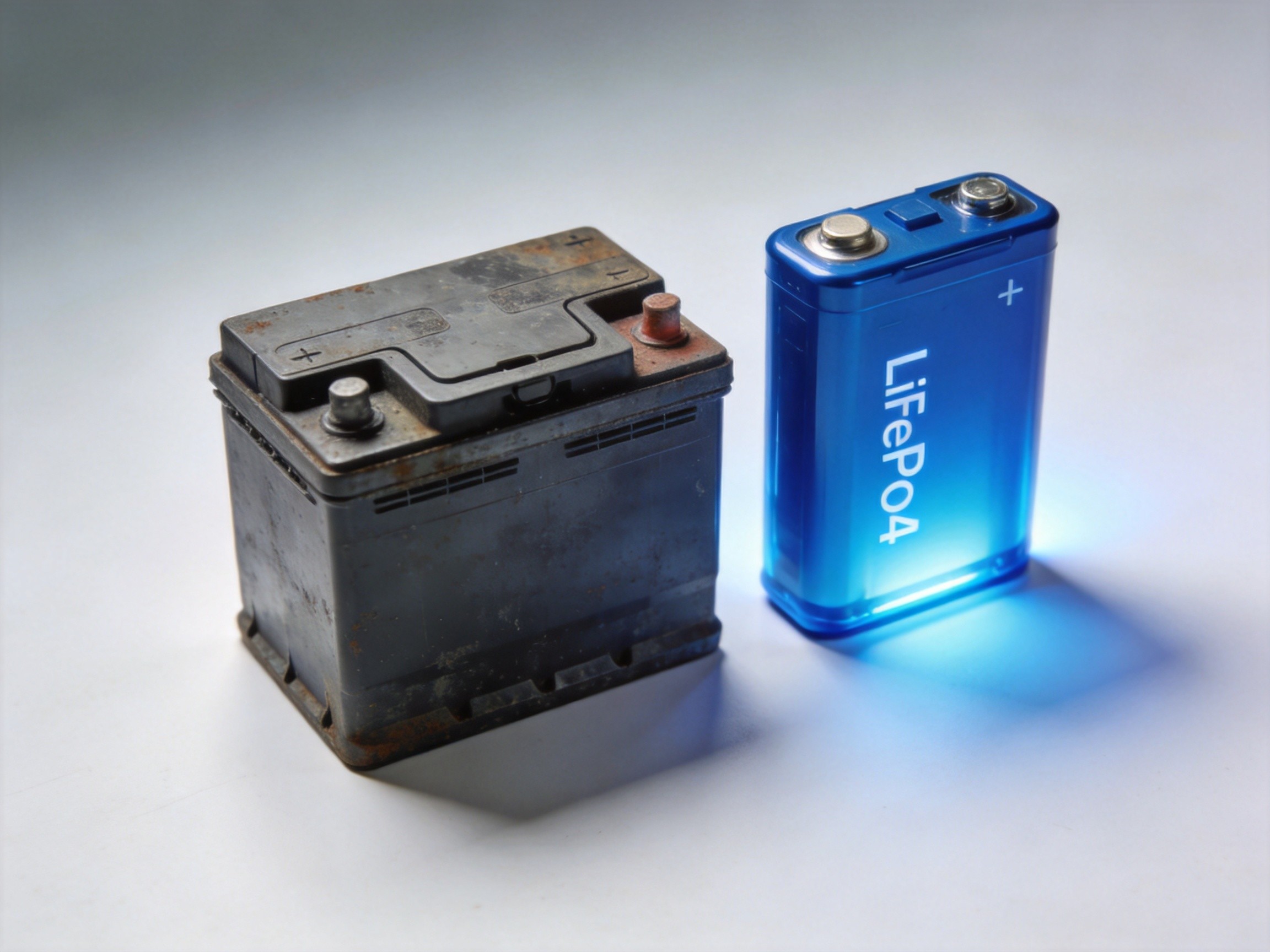
Can you overcharge a LiFePO4 battery? While it is physically possible to force an overcharge by bypassing safety mechanisms, a properly functioning Battery Management System (BMS) will automatically halt the charging process before any damage occurs. In practical applications, you cannot overcharge a LiFePO4 battery because the BMS enforces strict voltage cutoffs, protecting the cells from thermal runaway and ensuring long-term reliability.
What Happens When a LiFePO4 Battery is Overcharged?
When a lithium iron phosphate cell receives more voltage than its chemical structure can handle, the excess energy forces lithium ions to plate onto the anode in a metallic form. Why does this matter? Because metallic lithium plating reduces the active material available for energy storage, permanently decreasing the battery capacity. How does this physical change impact the system? It creates internal resistance and generates excess heat, which can compromise the structural integrity of the cell. Who is responsible for preventing this chemical degradation? The Battery Management System acts as the primary guardian, monitoring each cell's voltage in real time. If the voltage exceeds the safe threshold, the BMS opens the charging circuit. Without this electronic intervention, continuous charging would lead to electrolyte decomposition and gas generation. Even though LiFePO4 chemistry is inherently more stable than other lithium variants, it is not immune to the physical laws of electrochemistry. Pushing a 12.8V nominal system beyond its maximum absorption voltage will eventually trigger these degradation pathways. Therefore, relying on the native electronic protection is not just a recommendation, but a fundamental requirement for maintaining the rated 2000 to 4000 cycle life that these cells are engineered to deliver. For the broader safety picture — thermal runaway chemistry, extreme-condition behaviour and all-in-one ESS architecture — see our guide on whether LiFePO4 batteries are safe.
How Does the BMS Prevent Overcharging?
How does the BMS prevent overcharging? The Battery Management System utilizes a network of microscopic sensors to track the voltage, temperature, and current of every individual cell within the pack. First, the BMS compares the real-time voltage of each cell against a predefined overvoltage protection threshold. Second, if any single cell approaches this limit, the BMS immediately interrupts the charging current by opening the internal MOSFET switches. Third, the system performs passive or active cell balancing to ensure that no single cell reaches the cutoff voltage prematurely while others remain undercharged. At the CMJ Solar Jiangmen factory, engineers integrate these advanced BMS architectures directly into the battery housing to ensure seamless communication between the cells and the external charger. Why is this cell-level monitoring so critical? Because minor manufacturing variations can cause cells to drift out of balance over time. How does the BMS correct this drift? By bleeding off excess energy from the highest-voltage cells, allowing the entire series string to reach a full state of charge safely. Who benefits from this precise electronic management? Both the end-user, who gains peace of mind, and the system integrator, who can deploy the batteries without needing external voltage regulation hardware. For a full breakdown of BMS hardware, balancing methods and CAN/RS485 inverter communication, see our BMS explained guide. This integrated approach ensures that the energy storage solutions maintain their structural and electrical safety over the duration of the official 5-year warranty.
What Are the Safe Charging Limits for Lithium Batteries?
What are the safe charging limits for lithium batteries? Understanding the exact voltage parameters is essential for configuring your solar charge controllers and inverters correctly. For a standard 12.8V nominal system, the safe bulk and absorption charging voltage typically ranges between 14.2V and 14.6V. Why is this specific range optimal? Because it fully charges the lithium iron phosphate cells without pushing them into the overvoltage danger zone. How do you apply this to larger systems? For a 25.6V nominal system, the corresponding charging limit scales proportionally to between 28.4V and 29.2V. Who determines these exact parameters? The cell manufacturer provides the precise voltage curves based on extensive electrochemical testing. It is crucial to disable the equalization charge mode on your charger, as this mode is designed for flooded lead-acid batteries and will push voltages high enough to trigger the BMS cutoff repeatedly. Repeatedly hitting the BMS overvoltage limit will cause the charger to constantly disconnect and reconnect, leading to premature wear on the BMS relays and MOSFETs. CMJ Solar provides comprehensive OEM/ODM support to help distributors and integrators configure their compatible inverters to match these exact lithium charging profiles. By adhering to these strict voltage boundaries, you ensure that the battery operates within its designed electrochemical window, preserving the 2000 to 4000 cycle lifespan and maximizing the return on your energy storage investment.
How to Safely Charge LiFePO4 Batteries for Maximum Lifespan
Achieving maximum lifespan requires more than just preventing overcharge; it involves adopting a holistic charging strategy that minimizes stress on the cells. First, always use a charger or solar charge controller that features a dedicated lithium iron phosphate profile. Second, avoid leaving the battery at a 100 percent state of charge for extended periods, as holding maximum voltage accelerates calendar aging. Third, ensure that the charging temperature is within the acceptable range, typically between 0°C and 45°C, as charging lithium at freezing temperatures can cause irreversible lithium plating. During the bulk stage, the charger delivers maximum current until the battery reaches the absorption voltage. In the absorption stage, the voltage is held constant while the current gradually tapers off. Finally, the float stage maintains the battery at a lower resting voltage to compensate for self-discharge without overcharging. To explore more detailed strategies for preserving your investment, we recommend reading our guide on LiFePO4 Battery Maintenance: 8 Tips to Extend Lifespan. Additionally, the way solar energy is harvested plays a massive role in battery health. A properly configured maximum power point tracking device ensures that the energy entering the battery is stable and efficient. You can learn more about this dynamic in our article on How MPPT Charge Controllers Work in Solar Storage Systems. Why is temperature management so important during the charging phase? Because the internal chemical reactions generate their own heat, and external ambient heat can push the cell temperature beyond safe operating limits. How does the BMS respond to thermal stress? It will halt the charging process if the internal temperature sensors detect conditions that could lead to thermal runaway. Who is responsible for providing this environmental protection? The integrated BMS works in tandem with the physical battery enclosure to shield the cells from both electrical and thermal anomalies. If your projects run in colder climates, our guide to LiFePO4 cold-weather charging and heating covers the sizing and heater options involved.
Choosing the Right Energy Storage for Your Project
Selecting the correct battery architecture is the first step in ensuring safe and efficient charging. When upgrading from legacy systems or designing new off-grid solutions, you need a battery that natively supports lithium charging profiles and includes robust internal protection. The Lead-to-Lithium Battery 12.8V 100Ah offers a reliable 1280Wh capacity with a 100A discharge current, making it ideal for standard residential backups. The physical footprint is also a major consideration for system integrators. For instance, this 100Ah model features compact dimensions of 33 by 17.2 by 21.5 centimeters, allowing for dense rack mounting in confined server rooms or residential closets. For applications requiring higher continuous loads, the Lead-to-Lithium Battery 12.8V 200Ah delivers 2560Wh of energy and supports a robust 100A or 150A discharge current. If your system design operates on a 24V architecture, the Lead-to-Lithium Battery 25.6V 100Ah provides 2560Wh of capacity with a nominal 25.6V output and a 100A discharge capability. Why is it important to match the battery voltage to your inverter specifications? Because mismatched voltages will force the system to operate inefficiently or trigger fault codes. How do you ensure compatibility? By consulting the technical datasheets and verifying that the charge controllers are set to the exact voltage limits of the chosen battery model. Who can help you navigate these technical selections? The engineering team at CMJ Solar is available to assist with system design and component matching. To explore the full range of available configurations, visit our comprehensive energy storage catalog and find the perfect solution for your specific power requirements.
Frequently Asked Questions
Can a solar charge controller overcharge a LiFePO4 battery? No, as long as the charge controller is correctly programmed with a lithium iron phosphate profile, it will stop charging when the battery reaches the maximum absorption voltage, and the internal BMS will act as a secondary failsafe to cut off the current if the voltage exceeds the absolute limit. What happens if the BMS fails during overcharging? If the primary BMS were to experience a catastrophic electronic failure while the charger continues to push current, the battery would eventually exceed its safe voltage threshold, leading to electrolyte breakdown and potential thermal events, which is why using high-quality cells and redundant safety features from a reputable manufacturer is absolutely critical. Do I need a special charger for LiFePO4 batteries? Yes, you must use a charger that allows you to set the exact bulk, absorption, and float voltages for lithium chemistry, because standard lead-acid chargers often include high-voltage equalization stages that will repeatedly trigger the BMS overvoltage protection and degrade the system over time.
Ready to upgrade your power infrastructure with safe, reliable, and high-performance lithium iron phosphate technology? Whether you are sourcing for large-scale commercial deployments or residential backup systems, our engineering team is here to support your technical requirements. Please contact our team today to request a quote and discuss your specific project needs.
Part of the guide
LiFePO4 Battery Technology: Chemistry, BMS, Charging and Cold Weather
Need Product Recommendations?
Our team can help you select the right energy storage or solar lighting products for your project.