
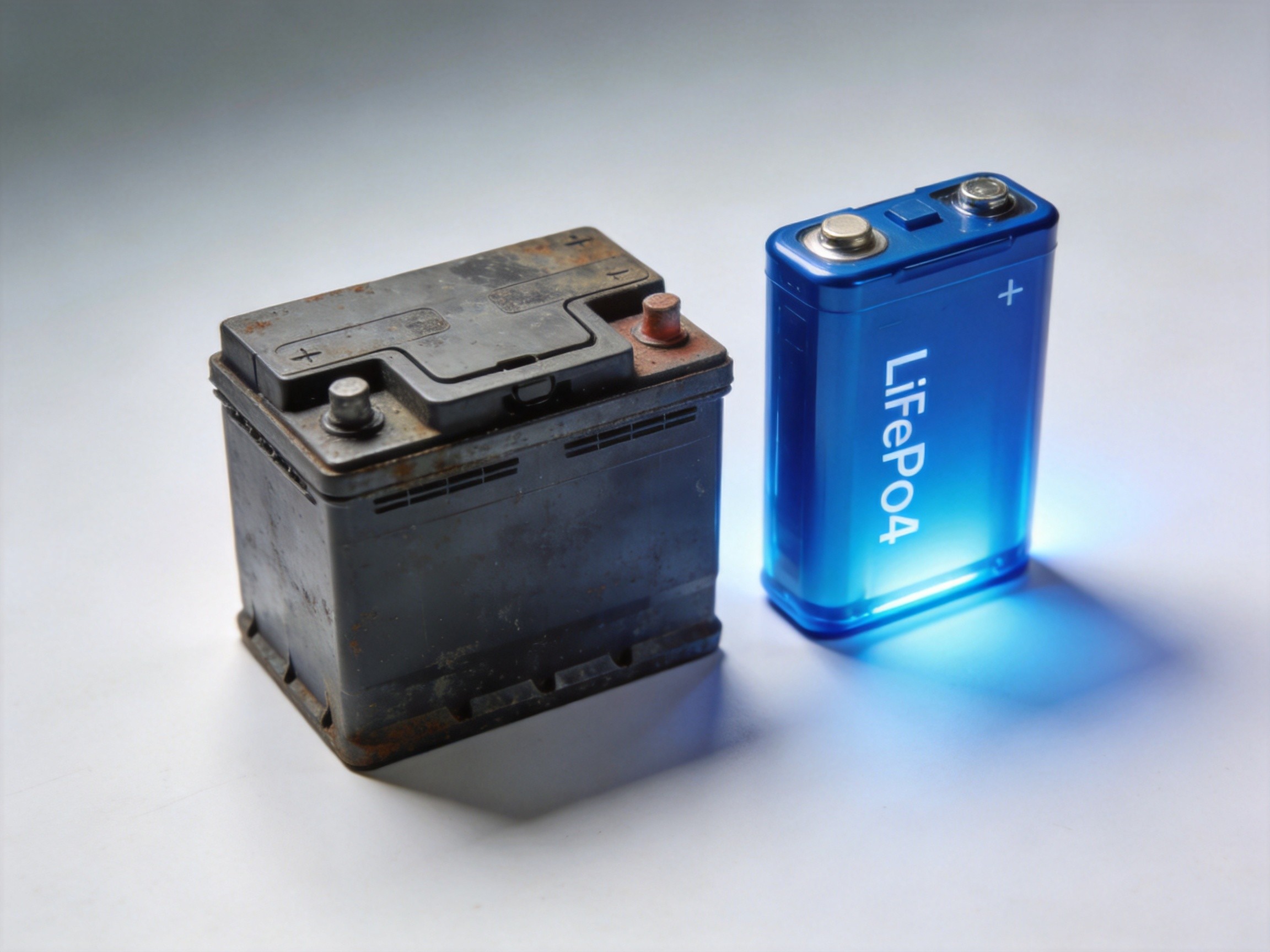
LiFePO4 batteries can discharge safely at temperatures as low as minus 20 degrees Celsius, but charging them below 0 degrees Celsius causes permanent lithium plating and must be blocked by the BMS. For solar storage in European winters, North American off-grid sites and high-altitude projects, the answer is low-temperature charge cutoff combined with insulation or self-heating and correctly oversized capacity.
What Cold Actually Does to LiFePO4 Cells
Cold affects charging and discharging very differently, and confusing the two is the most common mistake in winter system design. During discharge, low temperature simply raises internal resistance and thickens the electrolyte, so less energy is available immediately. Published cell and field data typically show LiFePO4 retaining roughly 80 to 90 percent of rated capacity at minus 10 degrees Celsius and about 60 to 80 percent at minus 20 degrees, depending on discharge current. This loss is temporary: once the pack warms, full capacity returns and no permanent damage has occurred.
Charging is the dangerous direction. At low temperature the graphite anode accepts lithium ions slowly. If charge current keeps arriving faster than the ions can intercalate, metallic lithium deposits on the anode surface instead of entering it, a failure mode called lithium plating. The plated lithium is electrochemically dead, raises internal resistance, and over repeated cold-charge cycles it can grow dendrites that threaten internal shorts. Damage accumulates silently: packs charged below freezing through one winter can come back in spring with 10 to 30 percent less capacity, and severe cases lose half.
The 0-Degree Charging Rule and BMS Cutoff
Mainstream prismatic LiFePO4 cells specify a charging window of 0 to 55 degrees Celsius, with some datasheets recommending 5 degrees as a practical floor. Quality BMS firmware therefore implements a low-temperature charge cutoff, usually set at 0 or 2 degrees to keep a safety margin. When the NTC probe reports a colder pack, the charge MOSFETs open: solar or grid charge current cannot reach the cells, while discharge is normally allowed to continue.
A morning freeze followed by sunrise is the classic trigger event. The array is already producing power, but the battery refuses it until the cells warm. This is protection, not a fault, and system designers should plan for it instead of overriding the threshold. At temperatures between 0 and 10 degrees, best practice is also to limit charge current to around 0.1C to 0.3C until the pack warms under load. Every CMJ Solar pack, including the Apollo A Series 10kWh All-in-One ESS, includes BMS temperature monitoring and cold-charge protection as standard, and the same principle applies to smaller 12V and 24V systems described in our 12V LiFePO4 applications guide.
How Self-Heating Battery Systems Work
Self-heating packs add one or more heating elements, usually flexible heating films or PTC heaters bonded to the cell sides or base, driven from the battery's own energy. The logic is simple: when the BMS sees a charge request and a cell temperature below the threshold, it closes the heater circuit first, warms the pack to roughly 5 degrees, and only then allows charging. Heater ratings for stationary cabinets commonly fall in the tens of watts per module, and field measurements suggest the daily heating overhead typically consumes around 5 to 15 percent of energy throughput in genuinely cold climates, with heavily insulated enclosures sitting at the lower end.
Two engineering details matter. First, heating must come from discharge-capable cells or an external supply, because a deeply frozen, nearly empty pack may struggle to warm itself. Second, heating without insulation wastes most of the energy, so film heaters are paired with foam or aerogel liners and sealed cabinets. Buyers who need guaranteed sub-zero charging, for example ski resorts, Baltic winter cabins or high-altitude telecom sites, should specify a heated variant and confirm the heater rating, trigger temperature and energy budget on the datasheet before ordering. CMJ Solar supports such configurations through OEM and ODM projects at the Jiangmen factory; standard catalog models rely on BMS cold-charge cutoff plus installation guidance.
Insulation, Placement and Passive Winter Protection
Active heating is not always necessary. Most European and North American residential systems solve the problem with placement. A wall-mounted pack such as the Athena Wall-Mounted Battery 5kWh (51.2V/100Ah) installed in a garage, utility room or insulated service closet rarely sees freezing cell temperatures even when the outdoor temperature falls well below zero, because standby losses and inverter warmth keep the enclosure a few degrees above ambient.
For outdoor and telecom installations, passive measures buy a great deal. Insulated battery cabinets with sealed cable glands, dark sun-facing placement that harvests daytime heat, and arranging modules away from cold outside walls all reduce the heating duty. Snow and ice clearance matters for the array side, because a snow-covered panel produces no morning energy precisely when the pack is coldest. The interaction between cold batteries, MPPT charging windows and taper current is explained in our article on how MPPT charge controllers work, and routine winter checks appear in our LiFePO4 maintenance tips.
Winter Operation, Commissioning and Long-Term Storage
Field commissioning in winter deserves its own checklist. If a system is installed during a cold snap, bring the batteries to full charge in a heated warehouse before the first outdoor solar charge, because a pack delivered at 30 percent state of charge may sit below the cutoff for several mornings before it can accept any solar current. Once running, installers should confirm on the inverter display that charge current genuinely drops to zero when cell temperature crosses the threshold and resumes after warm-up, which proves the protection chain end to end rather than merely existing on paper. Snow should be cleared from the lower edge of panels after storms, since even a narrow uncovered strip can restart charging early in the morning and warm the battery sooner.
Storage rules are equally important. Batteries taken out of service for the season should rest at roughly 50 to 70 percent state of charge in a dry, frost-free room rather than fully empty or fully charged, and should receive a top-up charge every two to three months. A pack that refuses charge on a freezing morning is behaving normally; a pack that permanently loses range after warming, or one whose cells drift apart over winter, usually points to repeated cold charging or a weak cell and should be reported with the BMS log. These habits cost almost nothing but separate ten-year installations from two-year warranty claims, which is why they are baked into our maintenance guidance.
Sizing Storage for Cold Markets
Cold sizing follows two deratings. Capacity should be oversized because the pack delivers less energy immediately at low temperature, and the PV array should be slightly oversized because short winter days and snow losses reduce harvest. As a starting rule, designers in regions with regular minus 10-degree nights add roughly 25 to 50 percent more nominal capacity than a warm-climate calculation suggests; sites that persist below minus 20 degrees may require up to twice the capacity or a heated cabinet. This is also why LiFePO4 still beats flooded lead-acid in winter despite the charging restriction: lead-acid capacity collapses further in cold, charging is inefficient, and frozen electrolyte can crack cases, as our LiFePO4 vs lead-acid comparison quantifies.
Commercial and telecom buyers serving remote cold sites often standardize on rack modules such as the Rack-Mounted Battery 5kWh (51.2V/100Ah) inside insulated outdoor cabinets, where parallel expansion lets capacity grow without replacing the BMS architecture. The full stationary range can be browsed in the energy-storage catalog.
Selection Advice by Region
For Western and Central Europe, indoor wall-mounted or indoor all-in-one systems with standard cold-charge cutoff are sufficient for nearly all homes, and CE-marked configurations support distributor compliance. For Scandinavia, the Alps, Canada and the northern United States, heated or insulated outdoor cabinets plus 25 to 50 percent capacity headroom are the defensible specification. For high-altitude markets such as the Andes, East African mountains and Central Asian telecom corridors, the combination of thin air, freezing nights and weak grid makes insulated rack systems with protocol communication the safest choice, because site visits are expensive and BMS cold protection must be fail-safe rather than user-managed.
Whatever the region, the procurement rule is the same: require the supplier to state the charge and discharge temperature windows, the BMS cutoff setting, the presence or absence of a heater and its energy budget, and the warranted capacity at a defined temperature. Vague claims that a battery works at minus 30 degrees usually describe discharge only. Distributors and EPCs can contact CMJ Solar with the project's lowest historical temperature and autonomy target, and our engineers will size the pack, heater and cabinet as one bill of materials.
Frequently Asked Questions
Can I charge a LiFePO4 battery below 0 degrees if I use a very small current? A few specialty cells permit ultra-low-rate charging around 0.05C to 0.1C slightly below freezing, but mainstream prismatic cells and standard BMS firmware should not be relied on for this. The safe design choice is to heat the pack above the cutoff first rather than trickle-charging a cold pack.
Does cold discharging permanently shorten battery life? No. Cold discharge raises internal resistance and temporarily lowers available capacity, but the effect reverses when the pack warms. The permanent winter threat is charging below the threshold, not discharging.
How much extra capacity should I specify for a winter off-grid home? Start with 25 to 50 percent more nominal kWh than a warm-climate load calculation in regions with regular freezing nights, and consider a heated or insulated cabinet where winters persist below minus 20 degrees. Confirm the final figure with the supplier against real weather data.
Need Product Recommendations?
Our team can help you select the right energy storage or solar lighting products for your project.