The Battery Technology Landscape
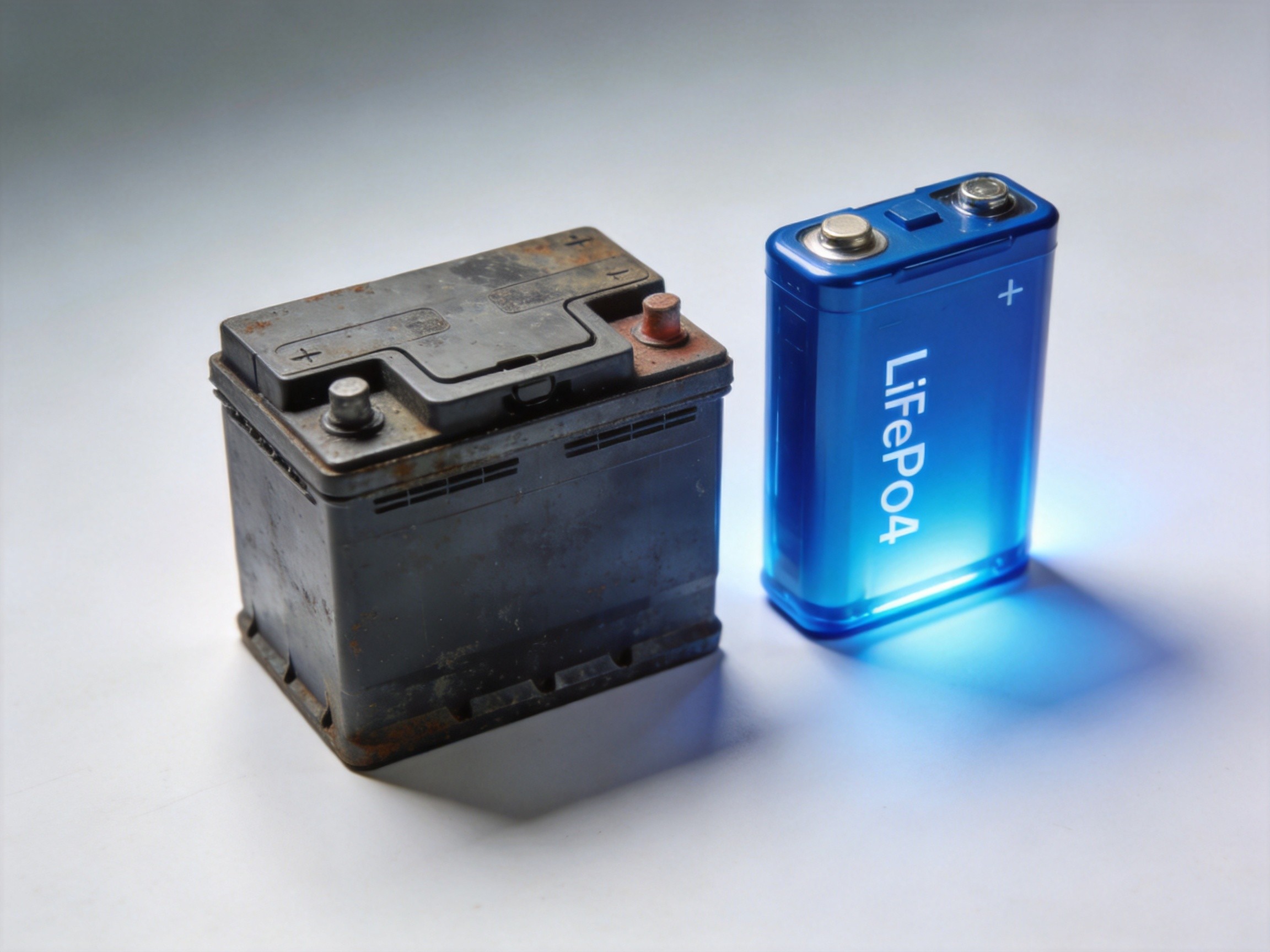
For decades, lead-acid batteries were the default choice for energy storage applications ranging from backup power to off-grid solar systems. However, the emergence of lithium iron phosphate (LiFePO4) technology has fundamentally shifted the landscape. For B2B buyers — solar installers, system integrators, and distributors — understanding the practical differences between these two chemistries is essential for making informed procurement decisions.
This comparison examines five critical dimensions: cycle life, safety, weight and form factor, total cost of ownership, and environmental impact. The data presented reflects CMJ Solar product specifications and general industry benchmarks.
Cycle Life: 2,000-4,000 vs 300-500
Cycle life is the single most important metric for energy storage batteries. It defines how many complete charge-discharge cycles a battery can deliver before its capacity drops below 80% of the original rating.
Lead-acid batteries typically deliver 300-500 cycles, depending on depth of discharge and maintenance quality. In a daily-use scenario, this translates to roughly 1-2 years of service before replacement is needed. LiFePO4 batteries, by contrast, deliver 2,000-4,000 cycles. CMJ Solar LiFePO4 energy storage products are rated for 2,000-4,000 cycles depending on the product line, corresponding to 5-10 years of daily cycling. This means a single LiFePO4 battery can outlast 4-10 lead-acid replacements.
The cycle life advantage also affects warranty terms. CMJ Solar offers a 5-year warranty on all LiFePO4 battery systems — a level of coverage that lead-acid manufacturers cannot match due to the shorter lifespan of their products.
Safety: Thermal Stability Matters
Safety is paramount in energy storage applications, particularly for residential and commercial installations where batteries are placed indoors or near occupied spaces. LiFePO4 chemistry is inherently safer than lead-acid in several ways.
LiFePO4 cells have strong thermal stability and are highly resistant to thermal runaway — the dangerous chain reaction that causes battery fires. The phosphate-based cathode material does not release oxygen at high temperatures, making self-ignition extremely unlikely. Lead-acid batteries, while generally stable, contain corrosive sulfuric acid and produce hydrogen gas during charging, which can create explosion risks in poorly ventilated spaces.
Additionally, LiFePO4 batteries do not require the regular maintenance that lead-acid demands. There is no need to check electrolyte levels, clean terminals of corrosion, or perform equalization charges. This reduces both labor costs and safety risks over the system lifetime. The built-in Battery Management System (BMS) in CMJ Solar LiFePO4 products provides automatic protection against overcharge, over-discharge, over-current, and short circuits — a level of safety management that lead-acid batteries simply cannot offer.
Weight and Form Factor
LiFePO4 batteries are approximately one-third the weight of equivalent-capacity lead-acid batteries. For example, a 12.8V 100Ah LiFePO4 battery from CMJ Solar weighs roughly 10-12 kg, while a comparable 12V 100Ah lead-acid battery weighs 25-30 kg. This weight difference has significant practical implications.
Lighter batteries reduce shipping costs — a major consideration for B2B buyers importing from China. They also simplify installation, allowing more flexible mounting options and reducing structural requirements. The CMJ Solar Lead-to-Lithium series (12.8V 100Ah, 200Ah, 300Ah models) is designed as a direct drop-in replacement for lead-acid batteries, matching form factors while delivering substantial weight savings.
Total Cost of Ownership
While lead-acid batteries have a lower upfront purchase price, their total cost of ownership over a 10-year period is substantially higher than LiFePO4. Consider this calculation: a lead-acid system costing 40% of a LiFePO4 equivalent may need replacement 4-5 times over the same period, plus ongoing maintenance labor and materials. The LiFePO4 system, with its 2,000-4,000 cycle life and 5-year warranty, requires zero maintenance and no replacement during that timeframe.
When calculated on a cost-per-cycle basis, LiFePO4 batteries are typically 2-3 times more economical than lead-acid over their respective lifetimes. For B2B buyers managing multiple installations, this difference compounds significantly across a project portfolio.
Environmental Impact
LiFePO4 batteries are more environmentally responsible than lead-acid in several ways. They do not contain lead or sulfuric acid, eliminating the risk of heavy metal contamination. Their longer lifespan means fewer batteries are manufactured, transported, and disposed of over time. LiFePO4 batteries are also more recyclable, with established processes for recovering lithium, iron, and phosphate materials.
Lead-acid recycling is well-established but energy-intensive, and improper disposal remains an environmental hazard in many regions. For companies with sustainability commitments or operating in markets with strict environmental regulations, LiFePO4 is the more compliant choice.
Conclusion: LiFePO4 Is the Clear Winner
Across every dimension that matters — cycle life, safety, weight, total cost, and environmental impact — LiFePO4 outperforms lead-acid. CMJ Solar has standardized on LiFePO4 technology across all energy storage product lines, from the modular Apollo series to the Athena wall-mounted batteries and the Lead-to-Lithium replacement series. All products carry a 5-year warranty and support 2,000-4,000 charge cycles.
If you are currently using lead-acid batteries and considering a switch, explore our Lead-to-Lithium conversion series for drop-in compatible replacements. For new installations, browse our complete energy storage product range or request a quote for OEM/ODM customization.
Need Product Recommendations?
Our team can help you select the right energy storage or solar lighting products for your project.