
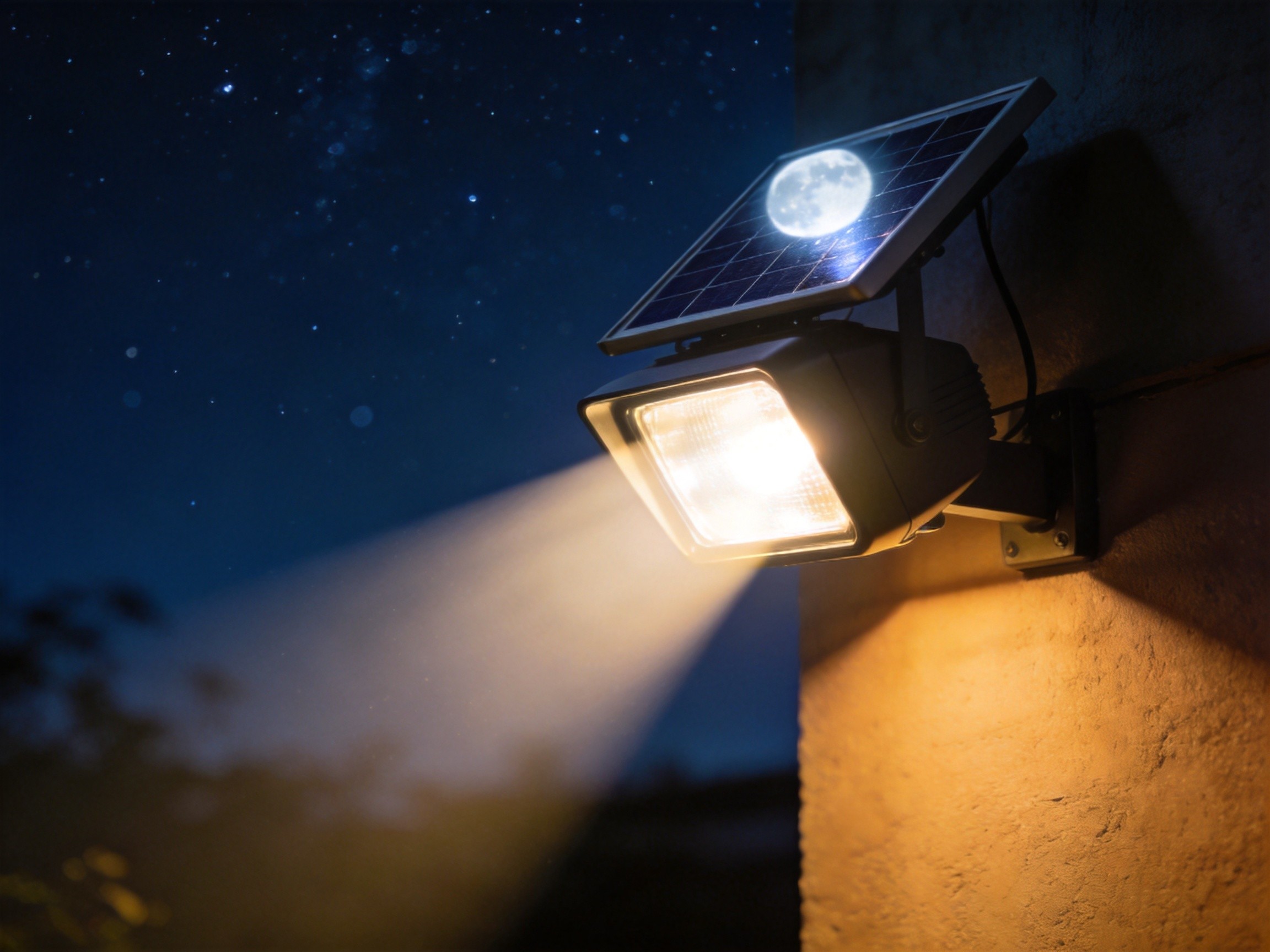
An all-in-one solar street light integrates four core components into one housing: a monocrystalline solar panel on top, a LiFePO4 battery, a smart controller with light and motion logic, and an LED light engine. Understanding how these four parts are matched explains why two fixtures labeled 200W can deliver very different real-world performance, and what buyers should inspect on the datasheet.
What 'All-in-One' Actually Means
In an all-in-one, sometimes called integrated, fixture the panel, battery, controller and LEDs share one aluminum or ABS housing mounted directly on top of the pole. There is no external cable run to a separate battery box, unlike split solar street lights where the panel sits high and the battery mounts low on the pole. The trade-offs between the two architectures are compared in detail in our article on all-in-one vs split solar street lights. For municipal and road tenders, the integrated design wins on installation speed, theft resistance and zero cable losses, which is why CMJ Solar builds the Navigator II and MJ-SSO series this way.
Component 1: The Solar Panel
The panel is the fixture's fuel station, and integrated lights almost universally use monocrystalline silicon cells because efficiency matters when roof area is the top surface of a street light. Modern mono modules convert around 19 to 22 percent of incident sunlight, hold up better than polycrystalline in weak morning light and overcast conditions, and can be made frameless and thin. Polycrystalline panels remain cheaper per nominal watt but need more area, which makes them a poor fit for compact integrated housings.
Panel sizing follows the battery voltage. CMJ Solar integrated fixtures use 4V nominal monocrystalline panels tuned to charge 3.2V nominal LiFePO4 cell packs. The Navigator II 100W carries a Grade A monocrystalline 4V/13W panel and fully charges in 6 to 8 hours of good sun, while its larger sibling, the Navigator II 600W, uses a 4V/25W panel to feed a 30Ah battery. On the heavier road-class side, the MJ-SSO200 mounts a 75W panel spanning roughly 1050 by 350 millimeters. Buyers should treat the panel-to-battery ratio as the single most important compatibility check: an undersized panel means the battery never reaches full charge in winter or in cloudy-season markets.
Component 2: The LiFePO4 Battery
The battery is what separates modern integrated lights from the older generation that used sealed lead-acid or gel cells. LiFePO4 chemistry tolerates deep cycling, lasts roughly four to six times longer in cycle count, and loses far less capacity during the high-temperature soak that a fixture under a metal panel experiences every afternoon. The Navigator II range uses Grade A LiFePO4 packs rated for 2000 cycles, from 10Ah to 30Ah depending on model, while the MJ-SSO series steps up to 60Ah, 85Ah, 105Ah and 170Ah packs rated for 4000 cycles.
Bigger batteries buy autonomy rather than brightness. Navigator II fixtures are engineered for about three rainy days of reserve, whereas the MJ-SSO100 through MJ-SSO400 family is specified for 4 to 5 rainy days, which is the critical parameter for monsoon markets. The battery sits in a sealed compartment inside the housing, and quality vendors use cells with consistent internal resistance so the pack ages evenly. Battery fundamentals for solar service are explained in our LiFePO4 vs lead-acid comparison.
Component 3: The Smart Controller
The controller is the fixture's brain, sitting between panel, battery and LEDs, and it performs five functions. It regulates charging with a solar charge profile matched to LiFePO4, it disconnects the load at low voltage to protect the cells, it switches the light on at dusk and off at dawn by reading panel voltage, it runs the timing schedule, and it processes motion input from the sensor.
Motion sensing on current-generation integrated lights is usually microwave radar rather than passive infrared, because radar penetrates rain and dust better and tolerates the lens contamination common on roads. Sensor detection distance on the Navigator II models is 6 to 8 meters. The control logic typically offers selectable profiles: steady-on all night at constant brightness, a fixed 2 or 3 hours of full brightness after dusk followed by radar-boost mode, or full radar mode where the fixture dims to a standby level and jumps to full output when movement is detected. The MJ-SSO line adds smart light control and infrared remote configuration, and the MJ-SSTH1200 additionally exposes a physical power button for maintenance crews. Radar duty-cycling is what makes multi-night autonomy possible on a modest battery: the light spends most of the night at low power rather than burning full watts into an empty street.
Component 4: The LED Light Engine
The LED engine turns stored energy into useful lumens, and its quality determines both brightness and longevity. Fixtures use surface-mount chip families such as 2835 for cost-effective high-count arrays, 3030 for road-class output, and 5050 for higher per-chip flux. The Navigator II 100W populates 360 pieces of 2835 SMD LEDs for 1248 lumens over roughly 60 square meters, while the MJ-SSTH1200 uses 154 pieces of 3030 chips to produce 3840 lumens over about 300 square meters, and the MJ-SSO200 uses 90 pieces of 5050 chips for 6500 lumens. Color temperature runs from 6000K to 7500K across the range, the crisp daylight white preferred for road and security applications.
The LED board is bonded to the die-cast aluminum or AL6063 housing, which doubles as the heatsink. LEDs in solar fixtures are deliberately driven below their maximum rated current, because lower junction temperature is the cheapest way to extend lumen maintenance toward the battery's own service life. This is also why nameplate watts should be read as a class label rather than literal draw, a point our wattage guidance develops further.
How CMJ Solar Product Families Divide the Work
Within the integrated range the four components are scaled for different jobs rather than simply enlarged. The Navigator II family, from 100W to 600W, is the compact residential, pathway and side-road tier: small 4V panels from 13W to 25W, 10Ah to 30Ah batteries, three selectable lighting modes and three rainy days of reserve. The MJ-SSO family is the road and municipal tier, with 60W to 110W panels, 60Ah to 170Ah 4000-cycle batteries, IP65 AL6063 bodies and 4 to 5 rainy days at mounting heights up to 12 meters. The MJ-SSTH family occupies the value engineering tier, using ABS housings, 3030 chips, a physical power button and the same radar logic for cost-sensitive tenders that still demand IP65. Matching the family to the road class prevents both under-specification and paying for capability the site will never use. More sizing detail for public tenders is available in our municipal specification guide.
Housing, Pole Interface and IP Protection
The mechanical package is arguably a fifth core system. Premium housings pair AL6063 aluminum with Teijin PC optical covers, while value models use ABS with the same grade of PC lens; aluminum offers better heatsinking for high-output road lights. Every outdoor-facing seal matters, and the integrated CMJ Solar road fixtures carry an IP65 rating, meaning total dust protection and resistance to water jets from any direction. What the digits mean in practice, and when projects should demand IP66 or IP67, is covered in our IP rating explainer.
Mounting geometry must match the pole before tender documents are printed: the MJ-SSO series fits a 76-millimeter pole diameter with installation heights from 6 meters on the SSO100 up to 10 to 12 meters on the SSO400, while the MJ-SSTH series fits a 50-millimeter pole. Bracket options, tilt adjustment and wind-load rating should be checked per project. Wattage versus road width matching is tabulated in our solar street light wattage and road-width guide, and municipal tender framing is summarized in the all-in-one solar street light category.
How to Judge a Balanced Design
A well-engineered fixture tells a coherent story across all four components. The panel's daily harvest should exceed the nightly energy budget with margin for the project's worst insolation month, the battery capacity should deliver the claimed rainy-day reserve under the actual dimming schedule, the controller's modes should match the traffic pattern, and the LED count and chip type should support the stated lumens and area. A fixture that advertises huge wattage but pairs it with a tiny panel and battery fails this balance immediately. Distributors and project contractors can contact CMJ Solar for component-level datasheets, photometric data and OEM labeling options from the Jiangmen factory.
Frequently Asked Questions
Which component fails first on a cheap all-in-one solar street light? In practice the battery, followed by the controller. Low-grade cells age quickly under the daily high-temperature soak, and unbranded controllers may lack proper low-voltage cutoffs that accelerate the damage. Specifying Grade A LiFePO4 packs and asking for cycle-life data prevents most early failures.
Is radar sensing better than PIR on solar street lights? For road and perimeter use, microwave radar is generally preferred because it works through rain, dust and contaminated lenses and does not need a direct line of sight to body heat. PIR remains adequate for low-traffic garden and courtyard fixtures.
Can the panel and battery be replaced separately after years of service? On integrated fixtures both are modular and serviceable, but replacements must match the original voltage class and charge profile; always source factory-matched spares so the controller thresholds remain correct.
Need Product Recommendations?
Our team can help you select the right energy storage or solar lighting products for your project.