
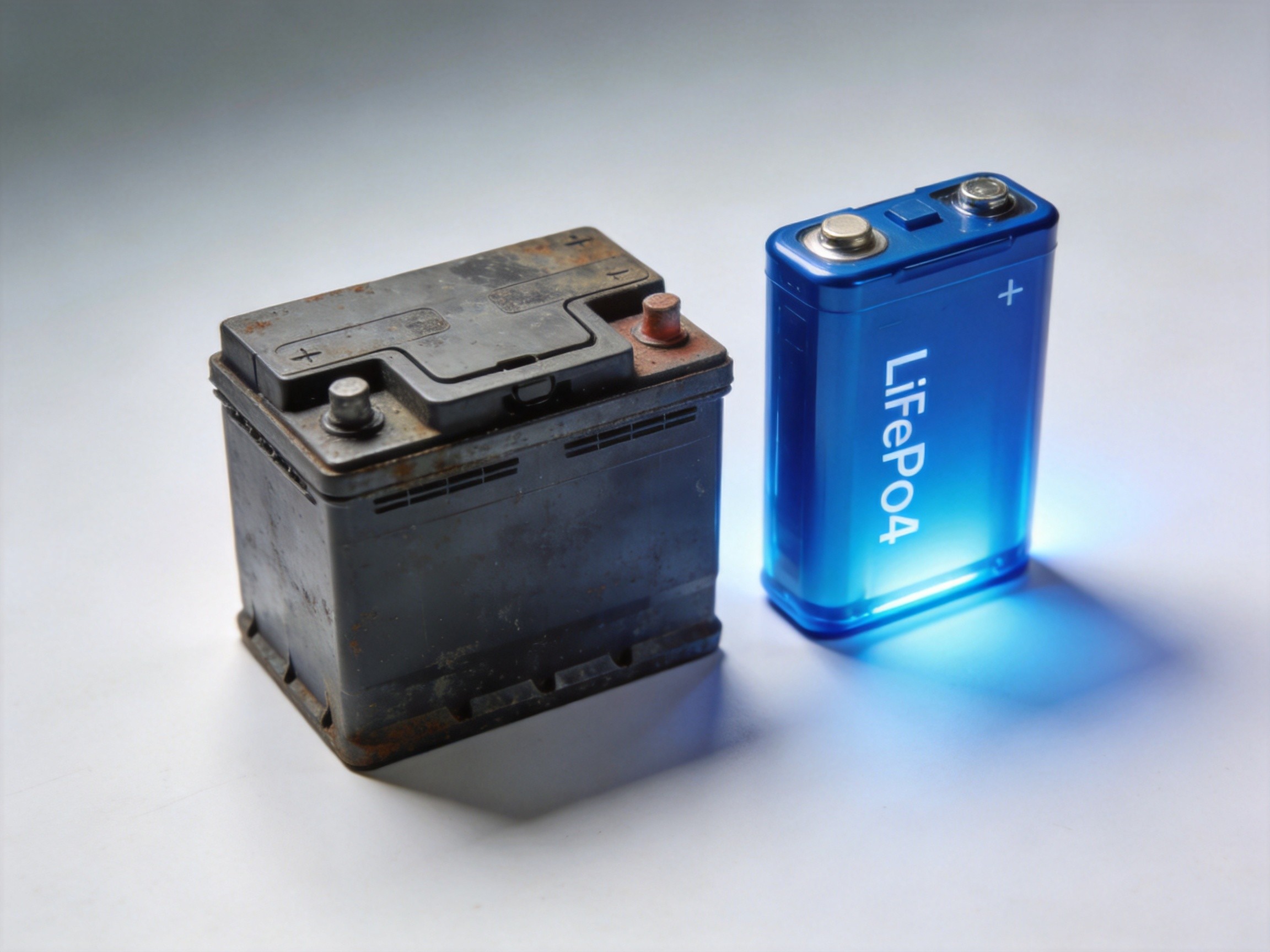
Distributors and installers repeatedly ask the same question: which 12V LiFePO4 battery capacity does a given application actually need? The answer is rarely obvious from a catalog. A 15Ah pack may be perfect for an e-scooter but comically undersized for a weekend cabin. Conversely, a 300Ah battery in a UPS application is budget wasted on capacity that will never be cycled. This guide maps the full <strong>12.8V LiFePO4</strong> capacity range to real-world loads, so you can specify the right model on the first attempt and stop losing margin to returns and re-orders.
CMJ Solar's Lead-to-Lithium battery series spans eight standard capacities from 15Ah to 300Ah, all built on prismatic LiFePO4 cells with an integrated BMS. Every unit is a drop-in replacement for a 12V lead-acid battery in terms of form factor and charging profile, delivering roughly one-third the weight and several times the cycle life.
Why 12.8V LiFePO4, and Why Now
The nominal voltage of a four-cell LiFePO4 string is 12.8V, which aligns with the 12V electrical architecture used in RVs, golf carts, scooters, alarm systems, UPS units, and small off-grid solar installations. Unlike lead-acid, which sags to 10.5V under load and requires a long absorption stage, LiFePO4 holds a flat 12.8V-13.2V discharge curve and accepts a full charge in roughly two hours when paired with the correct charger. The chemistry also tolerates deep cycling without damage. A lead-acid battery routinely discharged to 50% may last 500 to 800 cycles; a LiFePO4 battery at 80% depth of discharge typically exceeds 2,000 cycles. For B2B buyers, that translates into fewer warranty claims and a lower total cost of ownership over a five-year horizon, even though the upfront price per unit is higher. Distributors who make the total-cost argument during the sales conversation rather than competing on upfront price alone consistently report higher close rates and stronger repeat orders, because the end customer understands that a LiFePO4 battery is an investment rather than a consumable that needs replacement every two seasons.
Sizing Formula: Watts, Hours, and the 1.25 Safety Factor
Before selecting a capacity, calculate the daily energy demand of the load. The basic formula is straightforward: <strong>Daily energy (Wh) = Load power (W) x Runtime (h)</strong>, and <strong>Required capacity (Ah) = Daily energy (Wh) / 12.8V x 1.25</strong>. The 1.25 multiplier accounts for inverter losses if an AC load is involved, BMS cut-off at approximately 10V (roughly 90% usable capacity), and a small reserve margin. Rounding up to the next standard capacity is standard practice. For example, a 100W refrigerator running for eight hours consumes 800Wh. Divided by 12.8V and multiplied by 1.25 gives 78Ah, so a 100Ah battery is the correct specification rather than a 60Ah unit that would barely meet the load.
Charging Voltage: The 14.6V Rule
LiFePO4 cells require a bulk-absorption charge voltage of 14.6V for a 12.8V pack, followed by a float stage around 13.6V. Many existing lead-acid chargers deliver 13.8V to 14.4V and will partially charge a LiFePO4 battery, leaving 10 to 20% of capacity on the table. For maximum runtime, always pair the battery with a charger or solar charge controller set to the LiFePO4 profile. This is one of the most common installation errors reported by CMJ Solar technical support, and it is easily avoided at the point of sale by bundling a compatible charger.
Capacity Tier 1: 15Ah to 60Ah for Light Mobility and Standby
The 12.8V 15Ah battery stores 192Wh and supports a 15A continuous discharge. It is aimed at electric scooters, small mobility aids, portable tool batteries, and compact UPS units where runtime is measured in minutes rather than hours. Its compact 15.3 x 8.0 x 9.6 cm footprint fits the battery tray of most 12V scooters without modification. Moving up, the 12.8V 30Ah (384Wh, 30A discharge) and 12.8V 45Ah (576Wh, 45A discharge) share a 22.3 x 9.5 x 17.5 cm case and suit alarm backup systems, electric wheelchairs, and small trolling motors. The 30Ah is the volume seller for security installers who need a reliable 8 to 12 hour standby buffer; the 45Ah extends that to a full day or powers a 30-pound thrust motor for several hours.
The 12.8V 50Ah (640Wh, 50A discharge) and 12.8V 60Ah (768Wh, 60A discharge) use a slightly wider 22.8 x 13.8 x 20.8 cm case. These are the sweet spot for portable power stations, small solar lighting banks, and entry-level golf trolleys. The 60Ah in particular is popular with marine dealers running fishfinders and navigation electronics on a single overnight trip. A common mistake in this range is assuming that a higher Ah rating is always better; in a small scooter the extra weight of a 60Ah pack can reduce range and strain the motor mount. Match the capacity to the load, not to the maximum physical space available.
Capacity Tier 2: 100Ah, the Volume Standard
The 12.8V 100Ah battery, rated at 1,280Wh with a 100A discharge current, is the single best-selling capacity in the CMJ Solar 12V lineup. It is the default choice for RV house batteries, golf carts, dual-battery marine systems, and small off-grid cabins. Measuring 33 x 17.2 x 21.5 cm, it drops directly into the Group 27 / Group 31 footprint used by most lead-acid replacements. For price-sensitive markets, CMJ Solar also offers a 12.8V 100Ah Economy variant with the same 1,280Wh in an identical footprint but with an 80A BMS instead of 100A. It is the right choice when continuous loads stay below 1,000W and the application does not require high surge current, such as a single-battery RV replacement with no inverter larger than 800W.
When One 100Ah Is Not Enough
If the load calculation calls for more than 100Ah, users have two options: parallel two 100Ah batteries for 200Ah, or step up to a single 200Ah unit. Parallel connection is straightforward with CMJ Solar batteries because the integrated BMS handles current sharing automatically, but a single higher-capacity pack reduces cabling complexity and eliminates one set of interconnects that can loosen over time. For new installations, a single larger battery is usually preferred; for retrofits where the existing battery tray was designed for two Group 27 batteries, two 100Ah units may be the cleaner installation.
Capacity Tier 3: 200Ah to 300Ah for Serious Off-Grid
The 12.8V 200Ah battery stores 2,560Wh and supports a 100A/150A discharge current. Housed in a 52.2 x 24 x 21.8 cm case, it is designed for larger RVs with residential refrigerators, off-grid cabins powering lights and a small TV, and solar-powered telecom repeater stations. A single 200Ah battery can run a 200W load for roughly 10 hours after derating, which covers a typical evening plus overnight autonomy. At the top of the range, the 12.8V 300Ah delivers 3,840Wh and a 200A continuous discharge in a 52.2 x 26.8 x 22 cm case. This is the battery for serious off-grid homes, fishing boats with electric trolling motors and onboard electronics, and backup power systems for small businesses. At 200A, it can sustain a 2,500W inverter load, enough for a refrigerator, multiple lights, a router, and a small air conditioner cycling intermittently.
Parallel vs Series: A Quick Rule
All CMJ Solar 12.8V batteries can be paralleled for higher capacity (up to four units recommended) while maintaining 12.8V. They can also be connected in series up to 4S (51.2V) for 48V systems, but only identical capacities and ages should be mixed in series. For most 12V applications, parallel is the answer. If a customer needs 48V, point them toward the CMJ Solar 51.2V product family rather than series-wiring four 12V units, as the 51.2V packs include purpose-built BMS hardware.
Matching Capacity to Application
For distributors building a stocking order, here is how capacities map to the highest-volume verticals. E-scooters, UPS, and alarm systems generally need 15Ah to 45Ah. Mobility scooters and portable power stations fall in the 50Ah to 60Ah band. The 100Ah standard and its Economy variant cover RVs, golf carts, and entry-level marine. Off-grid cabins, larger boats, and small commercial backup sit in the 200Ah to 300Ah range. Stocking two SKUs from each tier gives most distributors the coverage to handle 80% of incoming enquiries without special-order lead times. Before quoting, ask three questions: total load wattage, required autonomy hours, and charging source (solar, alternator, or grid). These data points determine not just capacity but also whether a standard or Economy BMS is appropriate and whether parallel configuration should be recommended. Distributors who consistently capture these three inputs at the enquiry stage report significantly lower return rates and higher customer satisfaction, because the battery delivered matches the application from day one rather than requiring an upgrade or exchange after the first deep discharge.
Ready to Specify?
Browse the full CMJ Solar 12.8V LiFePO4 battery lineup for detailed specifications on every capacity from 15Ah to 300Ah, including the Economy 100Ah variant for cost-sensitive projects. CMJ Solar, manufactured by Guangdong Youzhuo Lighting Photoelectric Technology Co., Ltd., supports distributors with sample units, OEM branding, and technical documentation for every model in the range.
Need Product Recommendations?
Our team can help you select the right energy storage or solar lighting products for your project.