
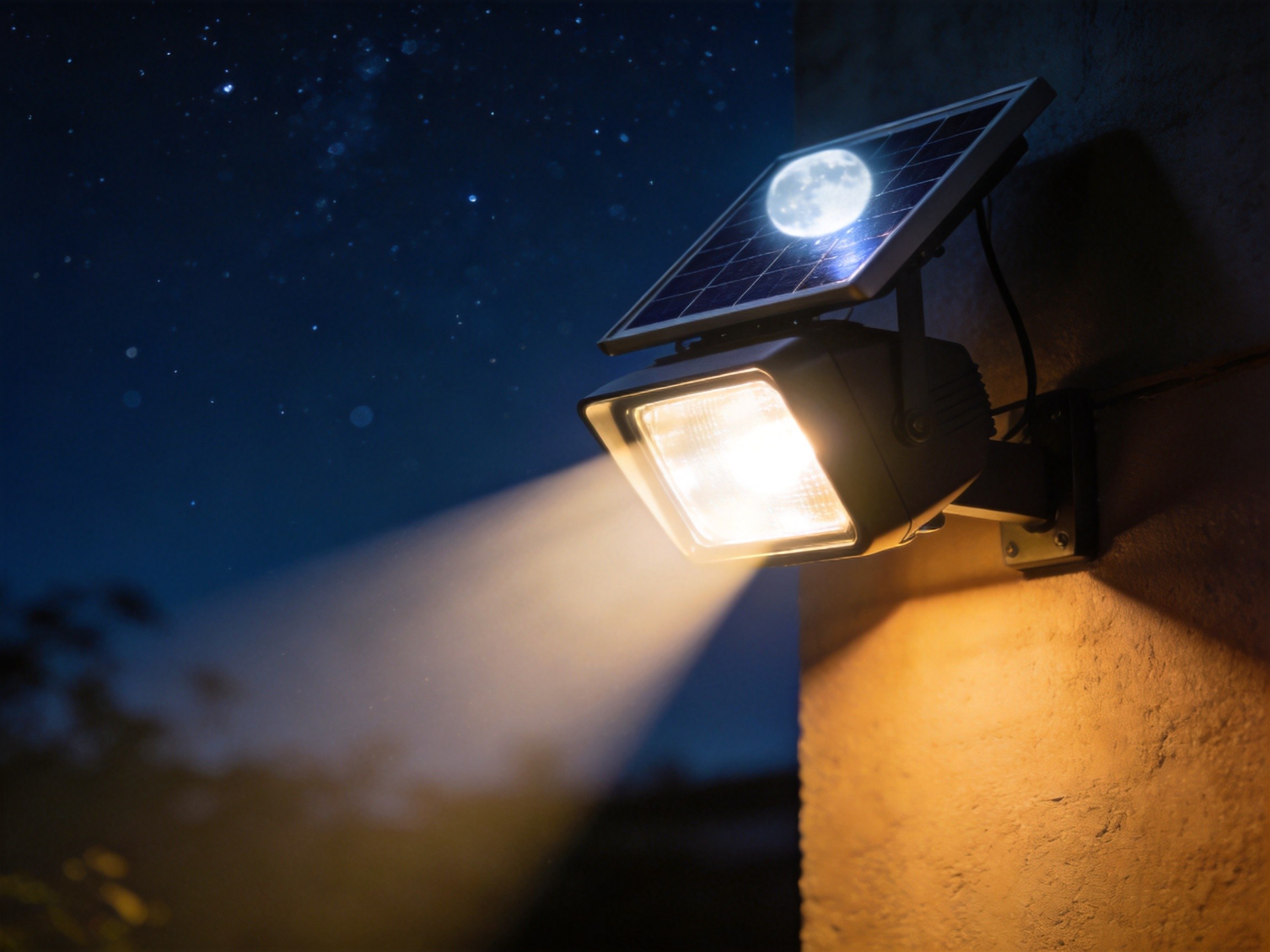
A 100W solar flood light typically produces between 896 and 1097 lumens, providing an effective illumination area of approximately 80 square meters. This brightness level is highly suitable for medium-sized commercial yards, residential driveways, and active construction sites, delivering sufficient visibility for security and operational tasks while operating entirely off-grid. Understanding the exact lumen output and coverage capabilities of these fixtures is essential for procurement managers and contractors who need to specify reliable outdoor lighting without relying on trenching or grid connections. When evaluating options in the solar flood light category, it is crucial to look beyond the wattage label and focus on the actual luminous flux and battery performance to ensure long-term operational success.
What Is the Exact Lumen Output of a 100W Solar Flood Light?
In the solar lighting industry, the wattage rating often refers to the equivalent halogen output or the maximum power draw of the LED array, rather than a continuous grid power consumption metric. Therefore, a 100W solar flood light does not consume 100 watts of electricity continuously; instead, it is engineered to deliver a specific lumen output that mimics the brightness of a traditional 100W halogen fixture. For example, the Alien 100W MJ-ALIEN-100W delivers a precise luminous output of 896 lumens by utilizing 136 pieces of highly efficient 5730 LED chips. On the other hand, the Breaker 100W MJ-BW100 achieves a higher output of 1097 lumens using 42 pieces of advanced 5054 LED chips.
Why does this distinction between chip types and lumen output matter? Because higher lumen output directly translates to better visual clarity for security cameras and human vision in dark environments, reducing blind spots around your property. How do manufacturers achieve such high efficiency from a 5V/18W monocrystalline solar panel? By optimizing the thermal management and reflector design inside the housing to minimize light loss and ensure that every generated lumen is directed toward the target area. Who benefits most from understanding these exact lumen figures? B2B buyers and project engineers who need to calculate the exact foot-candles required for compliance with local safety and security regulations.
How Much Area Does a 100 Watt Solar Light Actually Cover?
The physical coverage area of a solar flood light is just as critical as its raw lumen output, as it determines how many fixtures you need to purchase for a complete site illumination project. A standard 100W solar flood light is engineered to cover an illumination area of approximately 80 square meters. This specific coverage metric is calculated based on the optimal beam angle and a standard mounting height, ensuring that the light spreads evenly without creating harsh, concentrated hotspots. To put this into perspective, if you require broader coverage for a larger logistics yard, you might need to step up to the Alien 200W MJ-ALIEN-200W, which expands the coverage area to 150 square meters while delivering 1250 lumens.
Why is the 80 square meter coverage area so significant for commercial applications? Because it perfectly matches the footprint of a standard two-car driveway, a small loading dock, or a mid-sized equipment storage yard, providing comprehensive visibility without overlapping light pollution. How does mounting height affect this coverage area? Installing the fixture higher on a pole will widen the spread but reduce the intensity on the ground, whereas a lower mounting height will create a more intense, concentrated pool of light over a smaller area. Who should pay close attention to these coverage specifications? Site planners and security consultants who are designing a comprehensive lighting layout and need to avoid dark zones between fixtures while minimizing light trespass onto neighboring properties.
Which 100W Solar Flood Light Model Should You Choose for Your Project?
Selecting the right 100W solar flood light depends entirely on the specific operational requirements of your site, ranging from basic area illumination to advanced security monitoring. First, if you need maximum raw brightness for a general outdoor area and prefer a traditional floodlight aesthetic, the Alien 100W with its 896 lumens and 136 LED chips provides wide, even distribution alongside an 18-hour discharge time. Second, if your project requires higher lumen output and smart radar sensing for energy conservation, the Breaker 100W offers 1097 lumens, an IP65 rating for reliable weather resistance, and the ability to sustain operation for 2 to 3 rainy days. Third, if security monitoring is your primary concern and you need integrated surveillance, the Breaker Security 100W MJ-BW100C integrates a 400MP 1440P camera alongside 958 lumens of illumination, all managed via a smart application.
Why is it important to match the model features to your specific site conditions? Because a fixture with a radar sensor will significantly extend battery life in low-traffic areas by dimming when no motion is detected, whereas a security camera model provides critical visual evidence but requires a slightly larger battery capacity to operate the imaging sensors. How do these functional differences impact your total cost of ownership? By choosing a model with smart light control and remote control functions, facility managers can easily adjust brightness levels and operating schedules without needing to physically access the fixture. Who should consider the Breaker Security model? Retail parks, construction sites, and residential complexes where theft and vandalism are primary concerns and continuous visual monitoring is required.
How Do Battery Capacity and Cycle Life Impact Long-Term Brightness?
The battery is the heart of any solar lighting system, and its chemistry and capacity directly dictate how well the fixture will maintain its brightness throughout the night and over its operational lifespan. Both the Alien 100W and Breaker 100W models utilize a Grade A LiFePO4 15Ah battery, while the Breaker Security 100W is equipped with a slightly larger 18Ah battery to support the additional power draw of the integrated camera. These lithium iron phosphate batteries are manufactured at the CMJ Solar Jiangmen factory and are rigorously tested to ensure a cycle life of 2000 cycles, backed by a comprehensive 5-year warranty.
Why is LiFePO4 chemistry critical for maintaining consistent brightness in outdoor lighting? Because it prevents the severe voltage drop that causes LEDs to dim prematurely in the early morning hours, a common failure point in inferior lithium-ion or lead-acid alternatives. How does the 2000-cycle rating help B2B buyers justify the initial investment? It ensures the fixture maintains its capacity and brightness over multiple years of daily deep-discharge use, effectively protecting the return on investment and reducing the frequency of costly maintenance visits. Who benefits most from this robust battery specification? Distributors and EPC contractors who need to offer their clients a reliable, low-maintenance lighting solution that will perform consistently in extreme temperatures without degrading rapidly.
What Factors Can Reduce the Brightness of Your Solar Flood Light?
Even the most advanced solar flood light can experience reduced brightness if it is not installed and maintained correctly, making it essential to understand the environmental factors that impact performance. The primary factor is solar panel placement; the 5V/18W monocrystalline panel must be positioned in direct, unshaded sunlight for the majority of the day to fully charge the battery. Secondary factors include the accumulation of dust, dirt, and debris on the panel surface, which can block sunlight and reduce the charging efficiency by up to thirty percent. Furthermore, understanding the environmental protection of your fixture is crucial, which is why we recommend reviewing our guide on IP Ratings Explained: Choosing Weatherproof Solar Lights to ensure your chosen model can withstand local weather conditions.
Why does panel shading have such a dramatic impact on nighttime brightness? Because even a small amount of shade during peak sunlight hours can prevent the battery from reaching its full 15Ah or 18Ah capacity, resulting in the light dimming or shutting off before the 18-hour discharge cycle is complete. How can project managers mitigate these risks during the installation phase? By conducting a thorough sun-path analysis and ensuring the solar panel is mounted at the optimal angle for your specific geographic latitude, free from obstructions like tree branches or adjacent buildings. Who is responsible for ensuring optimal performance post-installation? The facility maintenance team, who should schedule bi-annual cleaning of the solar panels and check the connections, especially in areas with high dust or pollen counts, as detailed in our Solar Flood Light Buying Guide: Wattage, Lumens, Battery.
Frequently Asked Questions
How many lumens do I need for a secure outdoor area? For general security and visibility, an output between 800 and 1100 lumens is highly effective, which is exactly what a 100W solar flood light provides. This level of brightness eliminates dark shadows where intruders could hide while remaining energy-efficient enough to run all night on a 15Ah LiFePO4 battery.
Can a 100W solar light operate during consecutive rainy days? Yes, models equipped with larger battery capacities and efficient power management can sustain operation during poor weather. For example, the Breaker series is designed to support 2 to 3 rainy days of discharge, ensuring your site remains illuminated even when the 18W solar panel cannot generate sufficient power.
What is the difference between 5730 and 5054 LED chips in solar lights? The 5730 chips, used in the Alien series, are typically deployed in higher quantities to create a broad, uniform flood of light, whereas the 5054 chips, found in the Breaker series, offer high individual luminous efficacy, allowing the fixture to achieve higher total lumens with fewer chips and lower heat generation.
Ready to upgrade your outdoor lighting infrastructure with reliable, high-lumen solar solutions? Contact our team today to request a quote and discover how CMJ Solar can support your next commercial or residential project with premium OEM/ODM manufacturing and industry-leading LiFePO4 technology.
Part of the guide
Solar Flood Lights: Wattage, Lumens and Model Selection for Every Site
Need Product Recommendations?
Our team can help you select the right energy storage or solar lighting products for your project.