
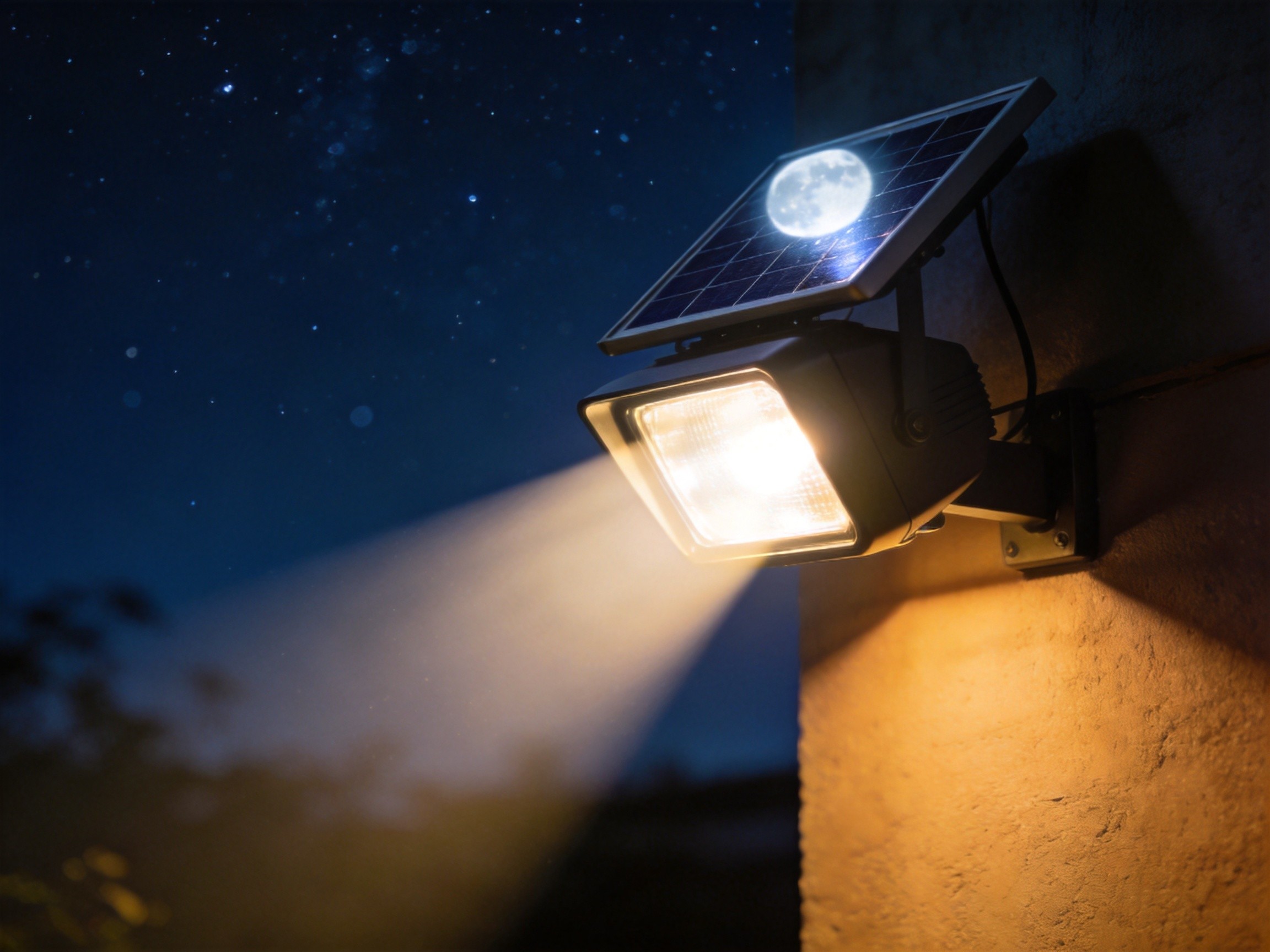
Remote properties, construction sites, farm perimeters, and small industrial yards share a common problem: they need bright light after dark and visual monitoring, but running grid power and network cable to each location is prohibitively expensive. A <strong>solar security light with camera 4G WiFi</strong> capability solves both needs in a single fixture. The solar panel charges a LiFePO4 battery during the day; at night, radar motion detection triggers both high-lumen flood lighting and video recording. The integrated camera streams to a phone app over a cellular data connection, allowing property owners to see live footage, receive motion alerts, and speak through two-way audio from anywhere in the world. For distributors and installers, the key decisions are which product tier to stock, whether to specify 4G or WiFi for a given site, how storage should be handled, and whether a single-lens or dual-lens camera is needed. CMJ Solar offers two families: the premium SSO-C series with AL6063 aluminum housings and 4500 to 12000 lumens, and the value-oriented SSTH-C series with ABS housings at 2550 to 3840 lumens.
SSO-C Series: Premium Aluminum Build for High-Demand Sites
The SSO-C, branded Starship I, is built around an AL6063 aluminum and Teijin PC housing that provides superior heat dissipation and impact resistance compared with plastic alternatives. It uses 5050 LED chips, a 2560 by 1440 camera resolution, and a low-power 4G cellular module. Every model supports two-way audio in AAC and G711 formats, H.264/H.265 dual-stream video compression, and SD card storage up to 256 gigabytes through the EseeCloud smartphone app. A 1/2.8-inch CMOS sensor and 3.6-millimeter fixed lens capture usable footage in daylight and under the fixture's own 6000 to 6500K illumination at night, with horizontal pan up to 263 degrees and vertical tilt up to 90 degrees at adjustable speeds from 0.1 to 20 degrees per second. Important note for buyers: the SIM card and TF card are not included with any SSO-C model. Distributors should supply a local nano-SIM with an active data plan and a compatible microSD card, or advise customers to purchase them separately.
SSO100C and SSO200C: Residential and Light Commercial
The MJ-SSO100C carries a 75Ah Grade A LiFePO4 battery, a 60W monocrystalline panel at 860 by 350 millimeters, and 45 LED chips delivering 4500 lumens at a 6-meter installation height with 4 to 5 rainy days of autonomy. It is well suited to large villas, small warehouses, farm building perimeters, and small business parking lots. The MJ-SSO200C upgrades to an 85Ah battery rated for 4000 cycles, a 75W panel at 1050 by 350 millimeters, and 90 LED chips for 6500 lumens at 6 to 8 meters. The larger battery and panel make it the preferred choice for sites that experience extended cloudy periods or where the camera streams frequently due to high foot traffic.
SSO300C and SSO400C: Industrial and Large Perimeter
The MJ-SSO300C uses a 105Ah battery, a 90W panel at 1270 by 350 millimeters, and 135 LED chips producing 8500 lumens at 8 to 10 meters. It is specified for construction sites, logistics yards, utility compounds, and agricultural storage areas where both broad illumination and camera coverage are needed across a wide area. The flagship MJ-SSO400C pairs a 170Ah battery with an 110W panel at 1600 by 350 millimeters and 180 LED chips for 12000 lumens at 10 to 12 meters. This unit covers large perimeters, port storage areas, and mining camps where a single fixture must replace multiple separate lights and cameras, and where the AL6063 housing's durability justifies the premium over plastic alternatives in high-vandalism or harsh-environment settings.
SSTH-C Series: ABS Housing for Value-Oriented Projects
The Starship III SSTH-C family uses ABS plus Teijin PC construction, which reduces cost while maintaining IP65 weather resistance. It uses 3030 LED chips at 6500 to 7500K and offers 4 to 5 rainy days of autonomy across all models, fitting a 50-millimeter pole diameter compared with the 76-millimeter tenon on the SSO-C. Every SSTH-C model includes smart light control, a power button, remote control, and radar sensor. The more compact body dimensions, 700 to 820 millimeters versus 932 to 1672 for the SSO-C, make the SSTH-C easier to ship in volume and simpler to install on smaller poles or wall brackets.
Single-Lens SSTH800C and SSTH1200C
The MJ-SSTH800C is equipped with a 36Ah Grade A LiFePO4 battery, a 30W monocrystalline panel at 574 by 295.5 millimeters, and 104 pieces of 3030 LED chips producing 2550 lumens over 150 square meters. It connects through the EseeCloud app with the same camera resolution, sensor, lens, and 263-degree pan range as the SSO-C series, making it a capable performer for residential and small-business applications where aluminum housing is not a requirement. The MJ-SSTH1200C steps up to a 54Ah battery, a 40W panel at 693 by 295.5 millimeters, and 154 LED chips for 3840 lumens over 300 square meters, adding meaningful coverage for farm yards, small construction sites, and retail parking areas.
Dual-Lens D Variants: SSTH800CD and SSTH1200CD
The MJ-SSTH800CD and MJ-SSTH1200CD add a second 3.6-millimeter fixed lens for dual-view monitoring. Rather than relying on a single pan-tilt viewpoint, the two lenses cover overlapping fields simultaneously, reducing blind spots that occur when a single camera pans away from an area. The D variants widen the horizontal pan range to 355 degrees and use the V380 app, which supports AOV (always-on video) low-power 4G operation for 24/7 recording on the 1200CD. Dual-lens models are particularly valuable for perimeter fence lines, building corners, and yard entrances where a single camera would need to constantly pan to cover two directions, potentially missing events during movement. The 1200CD's AOV mode maintains continuous low-frame-rate recording without draining the battery, switching to full-frame recording when radar triggers an event.
4G vs WiFi: How to Choose for Outdoor Sites
All CMJ Solar camera-integrated security lights use a low-power 4G cellular module rather than WiFi. This is an intentional design decision driven by the typical deployment environment. WiFi requires an existing wireless network within range of the fixture. Most construction sites, farms, and remote perimeters do not have one, and installing a WiFi access point outdoors adds cost, requires a weatherproof enclosure, and introduces a separate failure point that can take the camera offline if the router reboots or loses power. 4G, by contrast, only needs a SIM card with an active data plan and cellular coverage at the installation location. The low-power module is optimized for the intermittent data traffic of event-triggered recording and remote live view, keeping monthly data consumption modest, typically well under a standard 1GB plan for most residential and small-business use cases. For sites that do have reliable outdoor WiFi, a WiFi-based camera may be available from other manufacturers, but buyers should weigh the convenience of local network access against the risk of router outages, range limitations, and the need for additional networking hardware. In practice, 4G is the more robust choice for the outdoor, no-infrastructure locations where solar security lights are most commonly installed.
Storage Options: TF Card vs Cloud
Every CMJ Solar solar security light supports TF card storage up to 256GB. A 256GB card can store weeks of event-triggered H.265 footage depending on recording frequency, resolution settings, and whether dual-stream compression is enabled. Local storage has no recurring fee and works without an internet connection once configured, though retrieving footage requires connecting via the app remotely or physically removing the card. Cloud storage, where available through the EseeCloud or V380 app platforms, offers off-site backup and the ability to review footage even if the fixture is damaged, stolen, or the SD card is corrupted. It typically requires a monthly or annual subscription. Buyers should decide based on the site's security risk and budget: a residential driveway may be adequately served by local storage with motion alerts, while a commercial yard with high-value assets may benefit from the redundancy of cloud backup. A practical middle ground is to use a high-capacity TF card for primary storage and enable a low-cost cloud plan for critical event clips only.
Radar Triggering, Installation, and Range Planning
Both SSO-C and SSTH-C series integrate radar motion sensing with the lighting and camera systems. When the radar detects movement within range, the fixture raises light output from a low standby level to full brightness while simultaneously triggering the camera to record or send a push notification. This coordination means an intruder is illuminated and captured on color video at the same moment, rather than being recorded in low-light infrared mode by a separate camera. The light control function also allows dusk-to-dawn operation at reduced brightness, switching to full output and recording only when motion is detected, preserving battery life while ensuring the camera always has sufficient illumination for usable color footage.
On installation, SSO-C models fit a 76-millimeter pole diameter and are designed for 6 to 12 meter heights depending on model, while SSTH-C models use a 50-millimeter pole at lower mounting heights. The integrated solar panel must receive unshaded sunlight for most of the day, facing the equator (south in the Northern Hemisphere, north in the Southern Hemisphere) at a tilt angle appropriate to the local latitude. Partial shading from trees or buildings significantly reduces charging performance and should be avoided during site surveys. Both families carry IP65 ratings for dust and water-jet protection. For distributors building a product range, stock SSTH800C and SSTH1200C for price-sensitive residential customers, SSTH800CD or SSTH1200CD where dual-lens or 24/7 recording is requested, and SSO200C through SSO400C as premium options for commercial and industrial buyers. Explore the full solar security light lineup to compare specifications and identify the models that best match your market.
Need Product Recommendations?
Our team can help you select the right energy storage or solar lighting products for your project.