
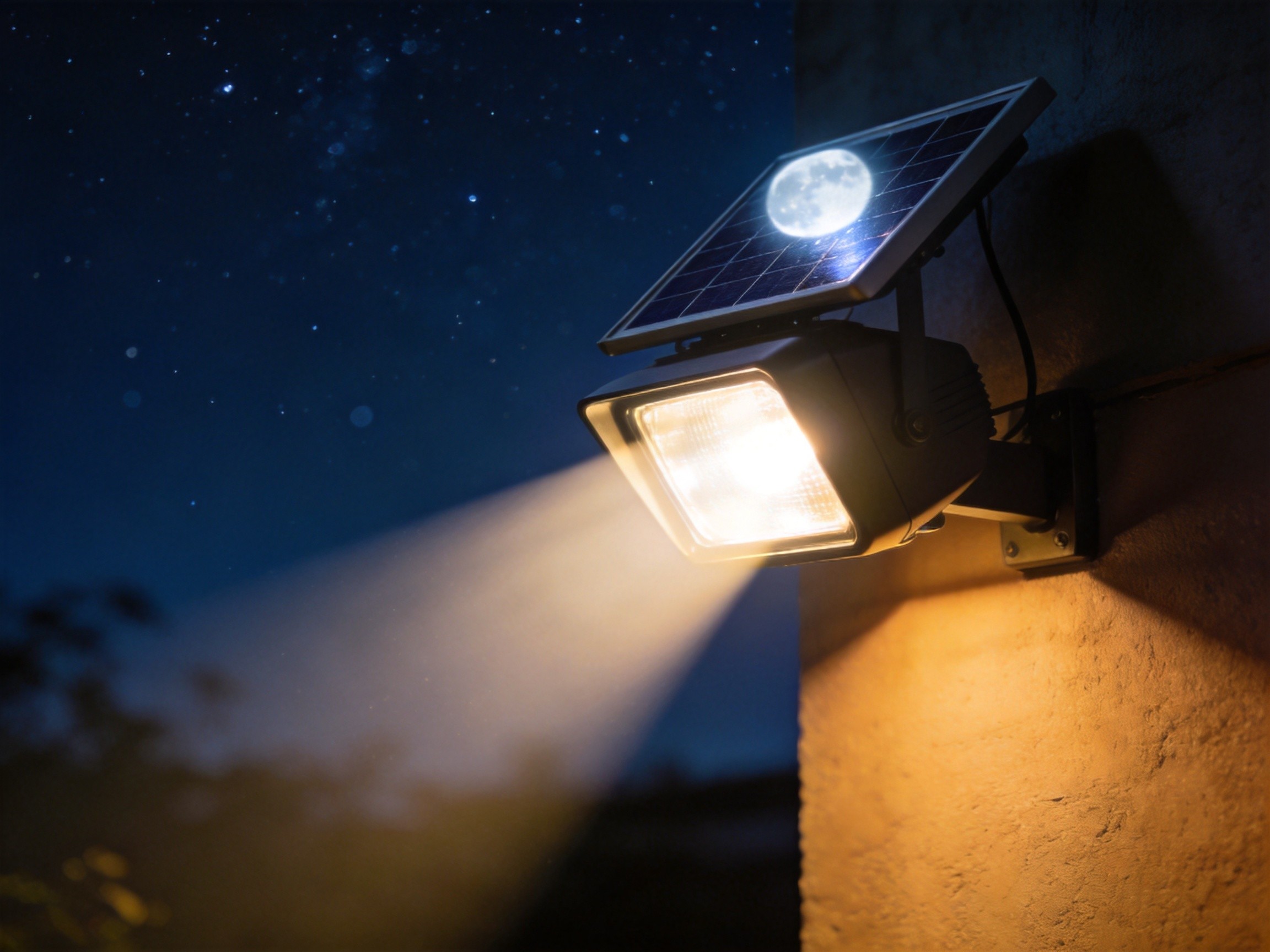
The traditional approach to outdoor security has always required two separate systems: lighting to deter intruders and illuminate the scene, and a camera to record and transmit footage. Each system needs its own power source, mounting location, wiring, and maintenance. A <strong>solar flood light with camera</strong> eliminates that duplication by integrating a high-resolution camera, motion-activated LED illumination, solar panel, and LiFePO4 battery into a single IP65 unit. For construction sites, farms, remote properties, and any location without grid power, this convergence is rapidly making separate camera-and-light installations obsolete.
CMJ Solar's Breaker Camera series spans six models from 100W to 1200W, all built on the proven Breaker flood light platform with an integrated 400MP (1440P) camera, app-based remote monitoring, radar-triggered recording, and two-way audio. The series is available through the CMJ Solar solar flood light catalog, and every model shares the same core feature set, with differences in light output, battery capacity, and panel size scaling with wattage.
Why Integrated Beats Separate
Installing a standalone solar camera and a separate solar flood light means two panels, two batteries, two mounting brackets, two sets of wiring, and two points of failure. It also means the camera and light may not coordinate: the light might activate on a timer while the camera records continuously, wasting battery on hours of empty footage, or the camera might trigger recording without the light activating, leaving nighttime footage too dark to be useful. An integrated unit solves both problems. The same radar sensor that detects motion and activates the flood light simultaneously triggers the camera to start recording. The LED array provides visible-light illumination for the camera sensor, producing clear color footage at night rather than the grainy black-and-white infrared image typical of standalone cameras. The solar panel and battery are sized to power both functions simultaneously, with a single charge controller managing the combined load.
Camera Specifications Across the Series
Every Breaker Camera model features a 400MP camera with 1440P (2560 x 1440) resolution, a 1/2.8-inch CMOS sensor, and a 3.6mm fixed lens. The camera supports H.264/H.265 dual-stream video compression and stores footage on a TF card up to 256GB. Two-way audio allows the operator to speak through the unit, which is useful for warning trespassers, communicating with delivery personnel, or checking on staff at remote sites. The camera connects via the EseeCloud app, available for iOS and Android, enabling live viewing, playback, and settings adjustment from anywhere with an internet connection. The app supports multiple cameras on a single account, so a security manager can monitor an entire site with dozens of units from one dashboard.
WiFi vs 4G: What Buyers Need to Know
The Breaker Camera series uses a 4G cellular connection rather than WiFi. This is a deliberate design choice for the target market. Construction sites, farms, perimeter fences, and remote properties rarely have reliable WiFi at the mounting location, and running a WiFi extender to a pole 8 meters in the air is impractical. A 4G connection requires a standard nano-SIM card with a data plan, which the installer or end customer sources locally. The SIM card and TF card are not included with the unit. Distributors should bundle or recommend a high-endurance 64GB or 128GB card at the point of sale, as the customer cannot record without one, and advise on local data plan options for 4G connectivity.
Model Range: 100W to 1200W
The Breaker Security 100W produces 958 lumens from 42 LED chips with an 18Ah battery and a 25W panel. It is designed for small entrances, garden gates, and residential driveways where the camera needs to cover a single approach. The compact 235 x 200 x 50 mm housing is discrete enough for residential applications while still providing 1440P video and motion-activated lighting. The Breaker Security 200W delivers 1,267 lumens with a 30Ah battery and a 30W panel. This is the most popular model for small business premises, farm building entrances, and construction site access gates. The increased battery capacity supports more frequent camera triggers and longer nightly illumination without depleting the charge. The Breaker Security 300W steps up to 2,017 lumens from 91 LED chips with a 36Ah battery and a 40W panel. It is specified for small parking lots, storage yards, and building perimeters where the camera needs to capture activity across a wider area.
The Breaker Security 500W produces 2,535 lumens with a 45Ah battery and a 45W panel. This is the entry point for medium commercial and industrial security: warehouse yards, factory perimeters, and equipment storage compounds. The camera's field of view combined with the flood light's coverage creates a monitored zone of approximately 200 square meters. The Breaker Security 800W delivers 3,038 lumens with a 54Ah battery and a 50W panel. It is the workhorse for large construction sites, logistics yards, and agricultural facilities covering 300 square meters or more. At the top of the range, the Breaker Security 1200W produces 3,510 lumens with a 60Ah battery and a 60W panel. It is specified for high-security perimeters, port facilities, mining camps, and large infrastructure sites. The combination of 1440P video, bright LED illumination, and two-way audio creates a comprehensive security node that replaces what would otherwise require a pole, a separate camera, a separate light, a separate solar power system, and a cellular router.
How Motion-Triggered Recording Works
The radar sensor detects movement within approximately 6 to 8 meters and simultaneously activates three functions: the LED flood light switches to full brightness, the camera begins recording at full resolution, and a push notification is sent to the operator's phone via the EseeCloud app. The light remains on for 30 seconds after motion stops, and the camera continues recording for a configurable period afterward. This coordinated response means that every recording is accompanied by clear, well-lit video, and the operator is alerted in real time rather than discovering an incident on the next morning's footage review. For sites that require continuous recording rather than motion-triggered clips, the camera can be configured for scheduled recording through the app. However, continuous recording consumes significantly more battery and storage, and CMJ Solar recommends motion-triggered mode for most solar-powered installations to maximize autonomy.
Night Vision and Image Quality
Because the LED flood light provides visible illumination when motion is detected, the camera records in color at night rather than switching to infrared. This produces substantially more useful footage: clothing colors, vehicle paint, and facial features are discernible in a way that black-and-white IR footage cannot match. In low-light situations without motion activation, the camera can still capture black-and-white IR footage using its built-in IR LEDs, ensuring that the scene is never completely dark. The 3.6mm lens provides approximately a 90-degree field of view, which is wide enough to cover a typical yard or entrance without the fish-eye distortion that wider lenses introduce. For large perimeters, multiple units spaced at 15 to 20 meter intervals provide overlapping coverage with no blind spots.
Installation and Connectivity Checklist
Before specifying a solar flood light with camera, distributors should confirm three site conditions. First, is there 4G cellular coverage at the installation location? A SIM card from a local carrier with at least 2GB of monthly data is required for remote viewing and notifications. Second, does the proposed mounting location receive at least 5 hours of direct sunlight on the panel per day? The panel is connected via a 3-meter waterproof cable, so it can be positioned separately from the light head if needed. Third, will the customer supply a TF card, or should one be bundled? CMJ Solar recommends a Class 10 or UHS-I card rated for high-endurance surveillance use. The panel and light head are pre-paired at the factory, so installation is as simple as mounting both components, inserting the SIM and TF card, and scanning the QR code in the app to add the device.
Applications Where Integrated Units Win
Construction sites are perhaps the single largest application for solar flood lights with cameras. Sites are temporary, have no grid power, contain high-value materials and equipment, and are frequent targets for theft. A 500W or 800W unit at each entrance and along the perimeter fence provides both illumination for safe night work and recorded evidence if an incident occurs. At the end of the project, the units are simply demounted and relocated to the next site. Farms and agricultural facilities are another strong vertical. Livestock theft, equipment theft, and unauthorized access are persistent problems, and running power to remote field entrances or pasture boundaries is often prohibitively expensive. A 200W to 500W unit at each gate or barn entrance provides monitoring without trenching or grid connection. Remote properties, vacation homes, and telecommunications sites round out the key applications. Any location with valuable assets but no grid power or WiFi is a candidate for an integrated solar camera light.
Stop Selling Separate Camera and Light
The integrated solar flood light with camera is one of the fastest-growing categories in outdoor security because it delivers better performance, simpler installation, and lower total cost than separate systems. Explore the full Breaker Camera series from 100W to 1200W, all with 1440P video, 4G connectivity, two-way audio, and motion-triggered illumination. CMJ Solar provides app setup guides, SIM configuration support, and distributor pricing for volume orders.
Need Product Recommendations?
Our team can help you select the right energy storage or solar lighting products for your project.