
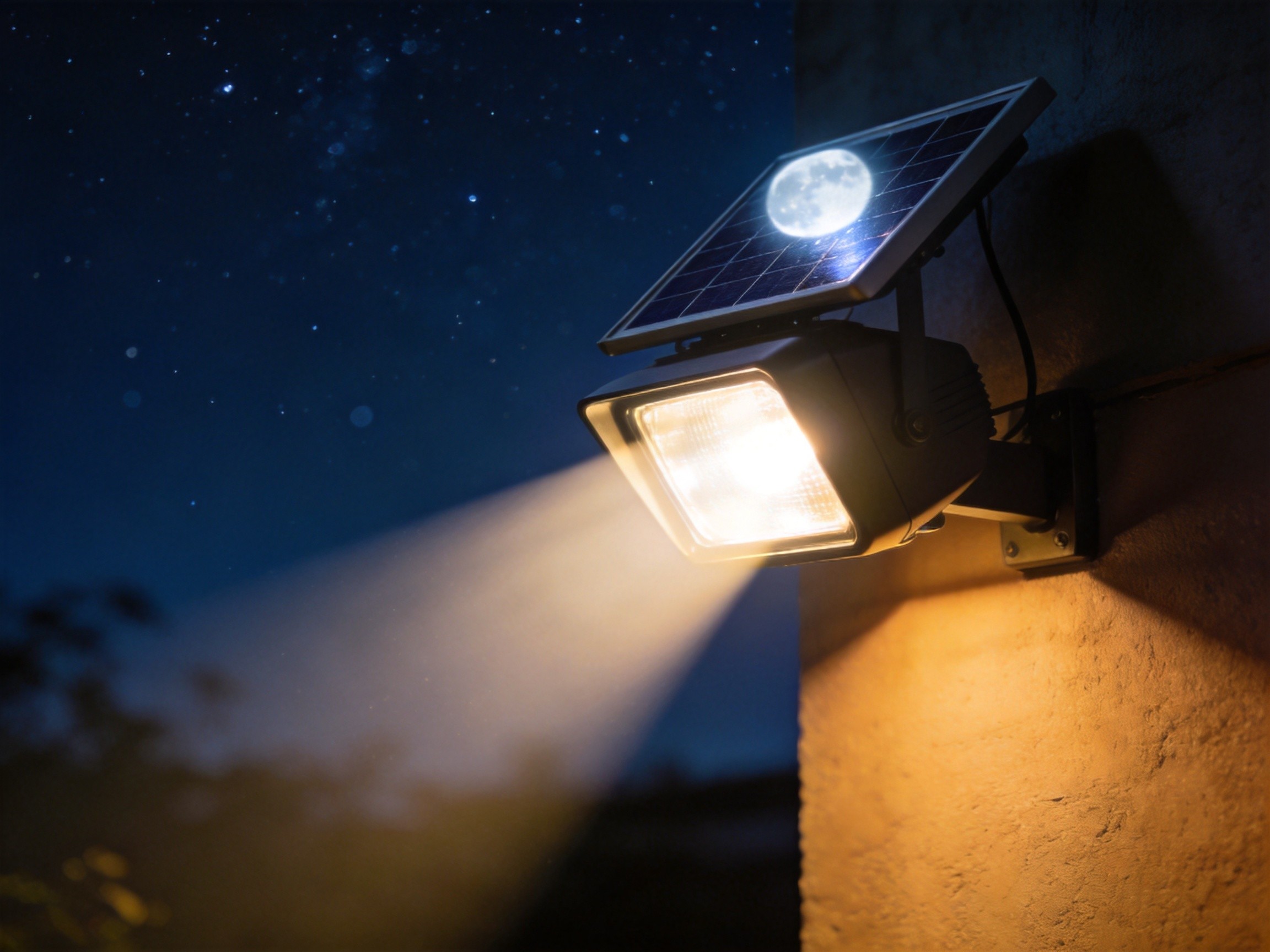
Specifying the wrong wattage for a solar flood light is an expensive mistake. Install a 60W unit over a warehouse loading yard and the night shift works in shadows. Install a 1500W unit over a residential garden and you waste budget, battery capacity, and panel real estate on illumination nobody needs. This <strong>solar flood light wattage guide</strong> maps the full 60W to 1500W range to coverage area, mounting height, and application type, using real lumen data from CMJ Solar's Breaker series so distributors and installers can size with confidence.
The CMJ Solar solar flood light catalog is built around the Breaker series, a workhorse line available from 60W through 1500W. Every model uses Grade A monocrystalline panels, LiFePO4 batteries rated for 2,000 cycles, 5054 LED chips, and an IP65 housing with a U-bracket for pole or wall mounting. The series also includes smart light control, remote control, and a radar sensor across the range, so feature differences are not a factor when choosing wattage; the decision comes down to light output, coverage, and runtime.
Understanding Lumens vs Watts for Solar Flood Lights
In traditional grid-tied lighting, watts are a rough proxy for brightness because the luminous efficacy of halogen or incandescent bulbs is consistent. For LED solar flood lights, watts measure the LED array's nominal power draw, not the light output. Two 500W lights from different manufacturers can produce dramatically different lumen counts depending on LED quality, driver efficiency, and optical design. Always compare lumens, not watts, when evaluating competitive products. CMJ Solar's Breaker series delivers between 10 and 12 lumens per watt across the range. The 60W model produces 620 lumens, the 200W produces 1,343 lumens, and the 1500W produces 5,500 lumens. These are real, measured outputs rather than theoretical LED datasheet maximums.
The Coverage Formula
A useful starting point for estimating coverage is: <strong>Coverage area (sqm) = Lumens / Target lux level</strong>. For general security and perimeter lighting, a target of 10 to 20 lux is typical. For task areas such as warehouse loading docks or construction sites, 30 to 50 lux may be required. A 200W light at 1,343 lumens covers approximately 67 to 134 square meters at 10 to 20 lux, which aligns with real-world testing showing effective coverage of about 100 square meters for driveway and small-yard applications.
60W to 200W: Residential and Small Commercial
The Breaker 60W is the entry point, producing 620 lumens from 42 LED chips with a 6Ah LiFePO4 battery and a 12W monocrystalline panel. It is designed for small residential yards, garden paths, porch entrances, and shed perimeters. Effective coverage is approximately 30 square meters at a mounting height of 3 to 4 meters. The 2-3 rainy day autonomy means it will continue operating through short overcast periods without direct recharge. The Breaker 200W steps up to 1,343 lumens from 63 LED chips, powered by an 18Ah battery and a 30W panel. This is the volume seller for driveways, small parking areas, farm building entrances, and residential perimeter walls. Coverage extends to roughly 100 square meters at a 4 to 5 meter mounting height. For distributors serving the retail and small contractor market, the 200W is the safest single SKU to stock in depth because it fits the broadest range of applications.
500W to 800W: Warehouse Yards and Medium Perimeters
The Breaker 500W produces 2,641 lumens from 130 LED chips with a 36Ah battery and a 45W panel. This is where the series crosses from residential into light commercial and industrial territory. It is specified for warehouse yards, small factory perimeters, construction site entrances, and large parking areas. Effective coverage is approximately 200 to 250 square meters at a mounting height of 5 to 6 meters. The Breaker 800W delivers 3,263 lumens from 165 LED chips with a 45Ah battery and a 50W panel. It is the most commonly specified model for medium warehouse loading areas, logistics yard perimeter lighting, and agricultural storage facilities. The 800W is also popular with rental companies supplying temporary lighting for outdoor events and construction projects, where its 2-3 rainy day autonomy reduces the need for generator backup.
Mounting Height Matters
At 500W and above, mounting height becomes a critical specification. A 500W light mounted at 4 meters produces a bright hotspot with rapid fall-off at the edges. The same light mounted at 6 meters spreads the beam more evenly across a wider area with lower peak lux but better uniformity. For warehouse and perimeter applications where even coverage matters more than maximum brightness, mount at 6 meters and angle the fixture at 15 to 20 degrees from vertical. This simple adjustment can eliminate the need for additional fixtures and reduce total project cost.
1200W to 1500W: Large Perimeters and Industrial Sites
The Breaker 1200W produces 3,795 lumens from 165 LED chips, powered by a 54Ah battery and a 60W panel. It is specified for large warehouse complexes, port storage areas, mining camp perimeters, and highway maintenance depots. Coverage extends to 400 to 500 square meters at a 6 to 8 meter mounting height. Multiple units spaced 15 to 20 meters apart can illuminate a continuous perimeter with minimal dark zones. At the top of the range, the Breaker 1500W delivers 5,500 lumens from 165 LED chips with a 100Ah LiFePO4 battery and an 80W panel. This is the light for the most demanding applications: container yards, large construction sites, sports courts, and high-security perimeter installations where the camera system requires a minimum lux level for facial or license-plate recognition. The 100Ah battery provides extended runtime and ensures that even after three consecutive rainy days, the light remains operational through the night.
Structural Considerations for 1200W-1500W
The 1200W and 1500W share the same 405 x 345 x 58 mm housing, but the 1500W's larger battery and panel require a more robust mounting structure. Distributors should advise customers to use poles rated for at least 25kg of static load at the top, with a foundation appropriate for local wind conditions. The included U-bracket fits standard pole diameters but may require an adapter for non-standard sizes. For wall-mounted installations on industrial buildings, verify that the wall material and anchor bolts can support the combined weight of the light head and panel under maximum wind load.
Battery and Panel Sizing Across the Range
One question distributors hear frequently is whether the solar panel is large enough to recharge the battery every day. CMJ Solar sizes each panel to fully recharge the battery from empty in 5 to 6 hours of strong sunlight, which is achievable in most tropical and subtropical latitudes year-round. In higher latitudes during winter, when daylight hours drop below 8 hours, the 2-3 rainy day reserve provides a buffer. The BMS manages charge current to prevent overcharging and extends battery life to the rated 2,000 cycles. For installations in regions with prolonged overcast seasons, such as Northern Europe or monsoon-affected areas, consider stepping up one wattage tier to gain the larger panel and battery, even if the coverage area does not require the extra lumens. The additional battery capacity buys another day or two of autonomy.
Radar Sensor and Lighting Modes
Every Breaker model includes a radar sensor with adjustable modes. The default setting activates full brightness when motion is detected within 6 to 8 meters and dims to a low-power standby after 30 seconds without movement. This extends runtime significantly compared to steady-on operation. For warehouse and perimeter applications where continuous illumination is required, the remote control can switch the light to steady-on mode. The third option combines 2 or 3 hours of steady-on at dusk followed by radar mode for the remainder of the night, which is useful for commercial premises that need full lighting during business hours and motion-activated security after hours. Distributors should walk customers through these three modes during installation to maximize both runtime and security effectiveness.
Common Sizing Mistakes to Avoid
The first and most common mistake is selecting wattage based on the area to be illuminated without considering lux requirements. A 200W light technically covers 100 square meters, but if that area is a loading dock where workers need to read labels and operate forklifts, 10 lux is insufficient and a 500W or 800W unit is required. The second mistake is mounting a high-wattage light too low, creating glare and wasted light. The third is ignoring the panel's solar access: a panel shaded by a roof overhang or tree canopy will not recharge the battery regardless of panel wattage. Finally, some buyers compare wattage labels across brands without checking lumens, ending up with a light that claims 800W but produces fewer lumens than a competitor's 500W. Always specify by verified lumen output.
Specify with Confidence
Use this guide to match the wattage to the application, then verify with a site survey for mounting height and solar access. The full CMJ Solar solar flood light range includes detailed specification sheets for every model from 60W to 1500W, and CMJ Solar's technical team can assist with lighting layout calculations for large perimeter and warehouse projects.
Need Product Recommendations?
Our team can help you select the right energy storage or solar lighting products for your project.