
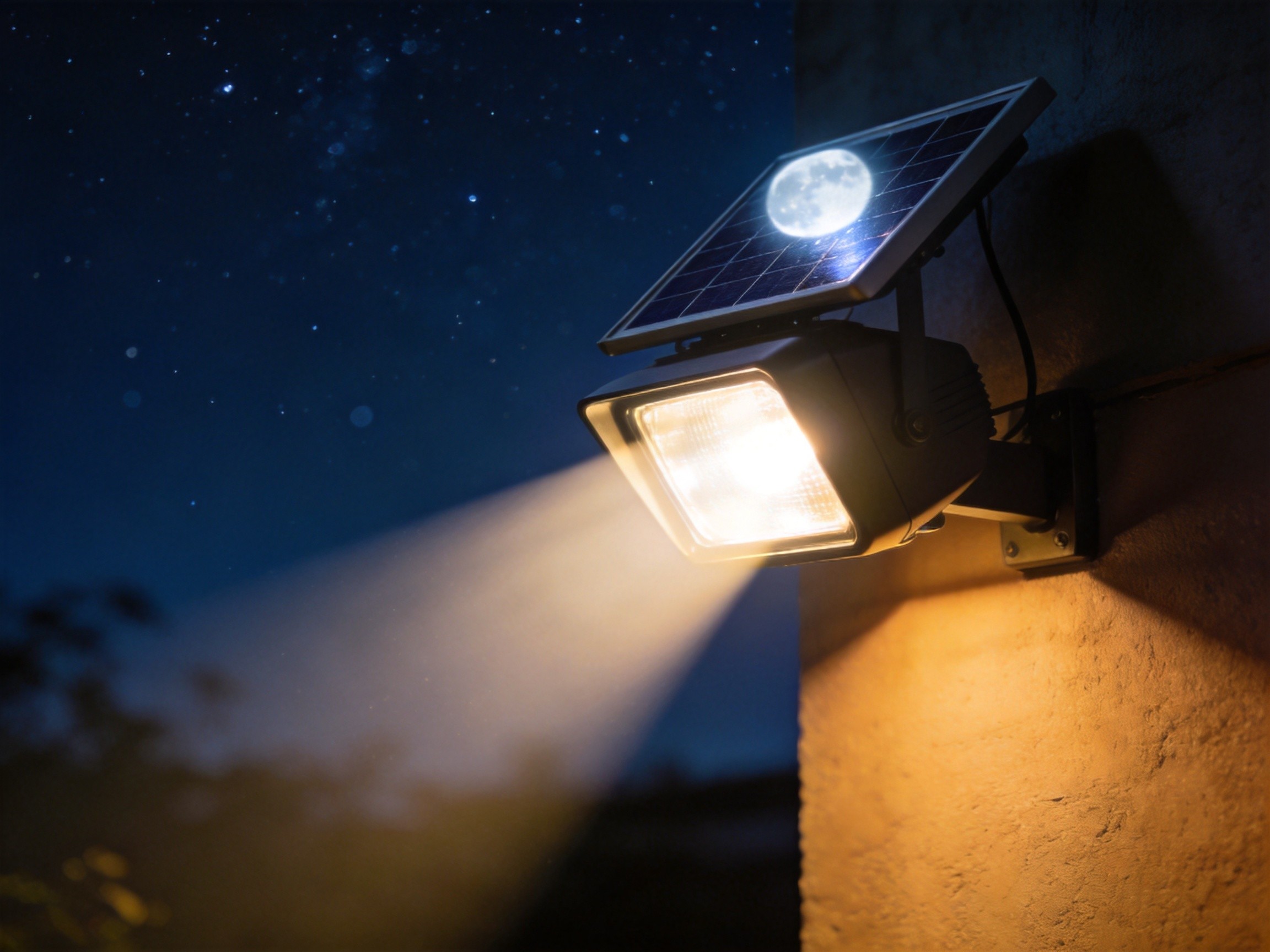
Project Overview
A regional logistics operator in the Middle East needed to illuminate a 50,000 square meter cargo yard and perimeter fence at a newly constructed distribution center. The site had no grid power connection at the perimeter, and trenching cables from the main building would have cost over $40,000. The operator required reliable nighttime lighting for security, loading operations, and worker safety, with zero ongoing electricity costs.
CMJ Solar was selected to design and supply a solar flood lighting solution using high-output Breaker series flood lights and all-in-one street lights.
Challenges and Requirements
The project presented several specific challenges:
- No grid power at the perimeter: Running conventional wired lighting required extensive trenching through paved yards.
- High ambient temperatures: Summer temperatures regularly exceed 45 degrees C, demanding batteries and panels rated for heat.
- Large area coverage: The 50,000m2 yard required uniform illumination for forklift and truck operations.
- Security integration: The client wanted motion-activated lighting to deter unauthorized access.
- Rapid deployment: The client needed installation completed within three weeks to meet an operational deadline.
- Zero operating cost: The business model required no ongoing electricity expense.
Solution Design
Working with the local installation partner, our engineering team designed a hybrid solar lighting layout combining two product types:
Perimeter Security Lighting
Twenty-four Breaker 200W solar flood lights were installed along the 1,200-meter perimeter fence at 50-meter intervals. Each Breaker 200W produces 1,343 lumens from a Grade A LiFePO4 18Ah battery, charged by a 30W monocrystalline solar panel. The radar motion sensor increases brightness when activity is detected, deterring intruders while conserving battery during quiet periods.
Yard and Loading Area Lighting
Twelve high-output Breaker 800W flood lights (3,263 lumens each) were mounted on 8-meter poles around the active cargo yard and loading docks. These units feature 45Ah LiFePO4 batteries and 50W solar panels, providing sustained illumination throughout the night. The IP65-rated aluminum housings withstand the region high temperatures and occasional sandstorms.
Entrance and Gate Lighting
Four Navigator II 200W all-in-one solar street lights were installed at vehicle and pedestrian entrances, providing 1,747 lumens of crisp white light with radar sensing for arriving vehicles.
Installation Process
The no-wiring design of solar flood lights enabled remarkably fast deployment:
1. Week 1: Site marking and foundation pouring. Forty pole foundations were excavated and poured using precast concrete bases.
2. Week 2: Pole erection and fixture mounting. A two-person crew with a bucket truck installed 8-12 fixtures per day.
3. Week 3: Commissioning, angle adjustment, and client handover. All fixtures were configured in radar-plus-timer mode and tested over three nights.
Total installation time was 18 working days, well within the three-week deadline. By comparison, a wired AC lighting solution was estimated to require 8-10 weeks due to trenching, cabling, and electrical inspection.
Configuration Details
Breaker 200W (Perimeter)
- Luminous output: 1,343 lumens
- Battery: Grade A LiFePO4 18Ah, 2,000 cycle life
- Solar panel: 30W monocrystalline
- Charge time: 6-8 hours
- Autonomy: 2-3 rainy days
- Functions: Light control + remote control + radar sensor
- IP rating: IP65
Breaker 800W (Yard)
- Luminous output: 3,263 lumens
- Battery: Grade A LiFePO4 45Ah
- Solar panel: 50W monocrystalline
- Charge time: 6-8 hours
- Autonomy: 2-3 rainy days
- Functions: Light control + remote control + radar sensor
- IP rating: IP65
Navigator II 200W (Entrance)
- Luminous output: 1,747 lumens
- Battery: Grade A LiFePO4 18Ah
- Solar panel: 18W monocrystalline
- Lighting area: 100 sqm
- Autonomy: 3 rainy days
- Functions: Remote control + light control + radar sensor
Results and Performance
Six months after commissioning, the client reported the following outcomes:
Zero Electricity Costs
The solar lighting system eliminated approximately $8,400 in annual electricity and grid connection fees that a wired LED solution would have incurred. Over the expected 10-year lifespan, the client projects over $80,000 in energy savings.
Reliable Nighttime Operation
Despite summer temperatures reaching 48 degrees C, all 40 fixtures operated continuously without failure. The LiFePO4 batteries maintained capacity through the hottest months, and the IP65 seals kept dust and moisture out during sandstorms.
Improved Security
The radar-activated perimeter lighting was credited with deterring two attempted after-hours intrusions within the first four months. Motion-triggered bright light startles potential intruders and draws attention to the perimeter.
Minimal Maintenance
Over six months, the only maintenance required was a single panel-cleaning visit after a sandstorm. There were no battery replacements, wiring faults, or fixture failures. The client now conducts panel cleaning on a quarterly schedule.
Rapid ROI
Including equipment, shipping, and installation, the project cost approximately 60% of the quoted wired AC solution. Factoring in zero energy costs, the client achieved full payback within 14 months.
Lessons Learned
Several insights emerged from this project that apply to similar commercial solar lighting deployments:
Right-Size Battery Capacity for Climate
In high-temperature regions, LiFePO4 batteries experience slightly faster self-discharge. Sizing batteries for 2-3 days of autonomy rather than the minimum 1-2 days provided a valuable reliability buffer during extended dust storms that reduced solar harvest.
Use Radar Mode Strategically
Perimeter lights in radar mode delivered the best combination of security and energy conservation. Yard lights, by contrast, were set to steady-on mode because forklift operations required constant illumination.
Panel Tilt Matters in Dusty Environments
Mounting panels at a steeper tilt angle (30 degrees rather than 15 degrees) helped dust and sand slide off during occasional rain, reducing cleaning frequency.
Conclusion
This logistics park project demonstrates that solar flood lighting is a practical, cost-effective solution for large commercial and industrial sites — particularly where grid power is unavailable or trenching is prohibitively expensive. By combining Breaker series flood lights for perimeter and yard coverage with Navigator II street lights at entrances, the client achieved reliable, zero-cost illumination with minimal maintenance and a rapid return on investment.
If you are planning a commercial or industrial lighting project, explore our solar flood light range and solar lighting catalog, or contact our project engineering team for a customized lighting design and bulk quotation.
Need Product Recommendations?
Our team can help you select the right energy storage or solar lighting products for your project.