
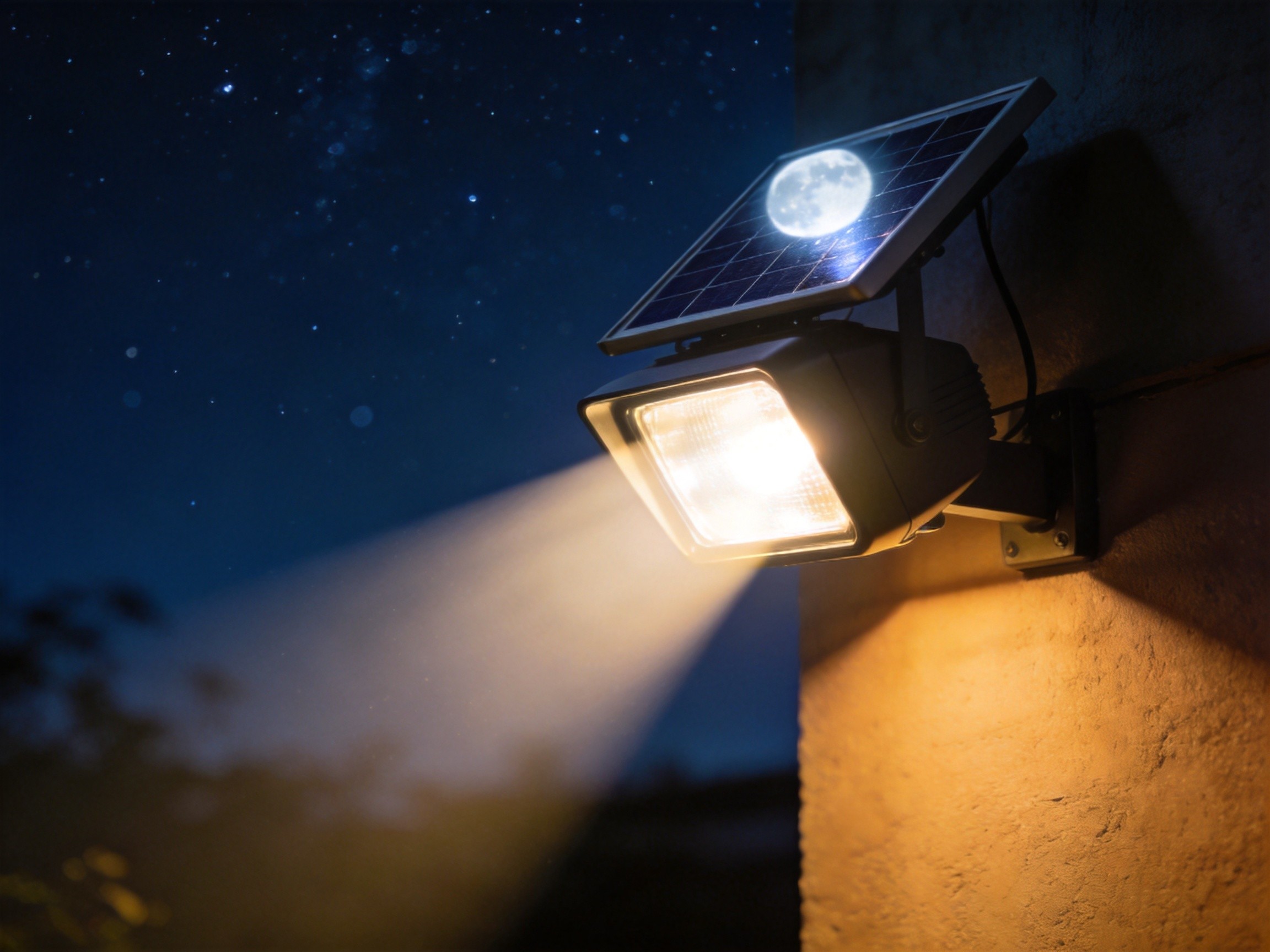
Static white solar flood lights dominate the security and utility lighting market, but a growing segment of customers needs something different: color. Hotels want to wash facades in brand colors for weddings and conferences. Event rental companies need portable, wire-free lighting that can shift from warm amber during dinner to dynamic colors during dancing. Landscape architects specify color-changing fixtures to highlight water features, specimen trees, and architectural details. An <strong>RGB solar flood light</strong> delivers all of this without trenching, wiring, or a grid connection, and CMJ Solar's Alien RGB series is purpose-built for these applications.
The Alien RGB series, available through the CMJ Solar solar flood light catalog, spans six models from 60W to 800W, each with RGB 5054 LED chips, Bluetooth app control, music rhythm synchronization, a remote control, and an integrated light sensor. Unlike white-light flood lights that exist purely for illumination, these units are lighting design tools that change the mood of a space at the tap of a phone screen.
Why Solar RGB Is Different from Wired RGB
Wired RGB flood lights have existed for years, but they require a constant AC power source, a DMX or WiFi controller, and in many cases a licensed electrician for installation. Solar RGB eliminates all three constraints. The panel charges the integrated LiFePO4 battery during the day, and the light runs entirely off stored energy after dark. There is no cable to run, no circuit to add, and no electrician required. For event rental companies, this means a fixture can be placed anywhere the sun reaches: in the middle of a garden, on a temporary pole, or on a rooftop terrace with no power outlet within 50 meters. The trade-off is that solar RGB lights have a fixed runtime based on battery capacity rather than unlimited grid power. CMJ Solar addresses this with 18-hour discharge time across the Alien RGB range, meaning even on a full night of operation the battery is not fully depleted. In single-color static mode, runtime extends well beyond 18 hours because the LEDs draw less current than in dynamic color-changing mode.
The Alien RGB Lineup: 60W to 800W
The Alien RGB 60W uses 24 RGB 5054 LED chips with a 6Ah LiFePO4 battery and a 12W monocrystalline panel, covering approximately 15 square meters. It is the ideal accent fixture for garden beds, patio pillars, small signage, and restaurant table-side ambiance. The compact 215 x 170 x 60 mm housing disappears into landscape plantings during the day. The Alien RGB 100W steps up to 39 RGB chips with a 15Ah Grade A LiFePO4 battery (rated for 2,000 cycles) and an 18W panel, covering 20 square meters. This is the entry-level architectural fixture, suitable for small building facades, garden walls, and event tent uplighting. Distributors report strong demand from wedding planners who use groups of 100W units in warm white or amber for ceremony lighting, then switch to color for the reception. The Alien RGB 200W uses 50 RGB chips with an 18Ah battery and a 30W panel, covering 30 square meters. It is the volume seller for landscape contractors lighting medium-sized trees, courtyard walls, and hotel entrance features. The 200W is also popular with restaurateurs for outdoor dining areas where color can be adjusted by season or event.
The Alien RGB 300W delivers 72 RGB chips with a 30Ah battery and a 40W panel, covering 40 square meters. This model is specified for larger architectural facades, hotel pool decks, and medium event stages. The increased battery capacity supports extended operation in dynamic color modes without compromising runtime. The Alien RGB 500W uses 95 RGB chips with a 36Ah battery and a 45W panel, covering 60 square meters. It is the workhorse for large event productions, hotel exterior lighting, and municipal landscape projects. A pair of 500W units can wash a two-story building facade in uniform color, while a group of four can illuminate an outdoor stage or festival area. At the top of the range, the Alien RGB 800W uses 95 RGB chips with a 54Ah battery and a 60W panel, covering 80 square meters. This is the fixture for large-scale applications: resort facades, theme park features, concert stages, and landmark buildings.
Music Sync: How It Works
One of the standout features of the Alien RGB series is music rhythm synchronization. The Bluetooth app uses the smartphone's microphone to detect ambient music and beat, then drives the LEDs to change color and brightness in time with the rhythm. For event applications, this creates a dynamic light show that responds to a DJ or live band without any additional controller or DMX hardware. Multiple Alien RGB units can be grouped in the app so they all sync to the same audio source, producing a coordinated effect across dozens of fixtures. For applications where music sync is not desired, the app offers a full color wheel with millions of selectable colors, adjustable brightness, and preset dynamic modes including fade, strobe, jump, and gradient. The included RF remote control provides basic color and mode selection for users who prefer not to use the app.
Bluetooth Range and Grouping
Bluetooth control has a typical range of 10 to 15 meters in open space, which is sufficient for most residential and small commercial applications. For larger installations such as hotel facades or event venues, multiple phones can connect to different groups of lights, or a single phone can control all units within range. The app supports grouping, scene saving, and timer scheduling, so a hotel can set the facade to warm white at dusk, switch to brand colors at 8 PM, and dim to a static color after midnight without staff intervention. This level of automated control is typically associated with expensive wired DMX systems, but the Alien RGB delivers it via a free smartphone app with no additional hardware.
Applications Where RGB Wins Over Static White
Hospitality is the largest vertical for RGB solar flood lights. A boutique hotel can use 200W and 300W units to wash its exterior in orange for a fall promotion, red and green for the holiday season, or the brand's signature color year-round. Static white lights cannot deliver this flexibility, and wired RGB systems require an infrastructure investment that many hotels are unwilling to make for accent lighting. Event rental companies are another fast-growing market. A typical wedding rental package might include eight 100W units for ceremony uplighting and four 300W units for reception color. Because the units are solar-powered and require no wiring, setup takes minutes rather than hours, and there are no cables for guests to trip over. The rental company charges per event, and the units pay for themselves after a handful of bookings. Landscape architects and garden designers specify RGB fixtures for water features, specimen trees, sculptures, and retaining walls, while holiday and festival lighting remains a seasonal but high-volume application for municipalities, shopping centers, and theme parks.
Durability and Outdoor Rating
All Alien RGB models feature IP-rated housings designed for permanent outdoor installation. The thickened cable with XT60 connector between the panel and light head is weather-sealed, and the U-bracket mounting system is made from corrosion-resistant materials suitable for coastal and high-humidity environments. The LiFePO4 batteries are rated for 2,000 charge cycles, which translates to approximately five years of nightly operation before capacity begins to degrade. The Grade A monocrystalline panels maintain over 80% of their rated output after 25 years, making these fixtures a long-term investment rather than a disposable seasonal product. For applications requiring precise color matching, such as brand logo illumination, CMJ Solar recommends testing a sample unit at the installation site before placing a volume order, as RGB LEDs produce color by mixing red, green, and blue and cannot perfectly replicate every shade, particularly pastels and warm whites.
Sizing RGB Flood Lights: A Different Calculus
Sizing an RGB flood light is less about lux levels and more about visual impact. The coverage area figures (15 to 80 square meters across the range) refer to the area that receives a visible color wash, not a specific lux measurement. For accent lighting on a wall or facade, one fixture per 3 to 5 linear meters is typical. For open-area color illumination such as a stage or dance floor, one 500W unit per 50 to 60 square meters provides sufficient intensity. For uplighting trees or architectural columns, a 100W or 200W unit at the base is usually adequate, with a 300W for larger features. Distributors should also consider that RGB fixtures are often used in groups rather than as single units. A hotel facade may need six to twelve units; a wedding setup may need eight to sixteen. Encourage customers to buy a sample to test color and coverage before committing to a full project quantity. For event rental and landscape contractor customers, consider bundling additional mounting poles, ground stakes, and spare remote controls to increase average order value.
Add Color to Your Catalog
RGB solar flood lights open new customer segments that white-light-only distributors cannot serve: hospitality, events, landscape architecture, and holiday lighting. The Alien RGB series from 60W to 800W offers a model for every application, all with Bluetooth app control, music sync, 18-hour runtime, and Grade A LiFePO4 batteries. Contact CMJ Solar for sample units, distributor pricing, and marketing materials to launch this high-margin category in your market.
Need Product Recommendations?
Our team can help you select the right energy storage or solar lighting products for your project.