
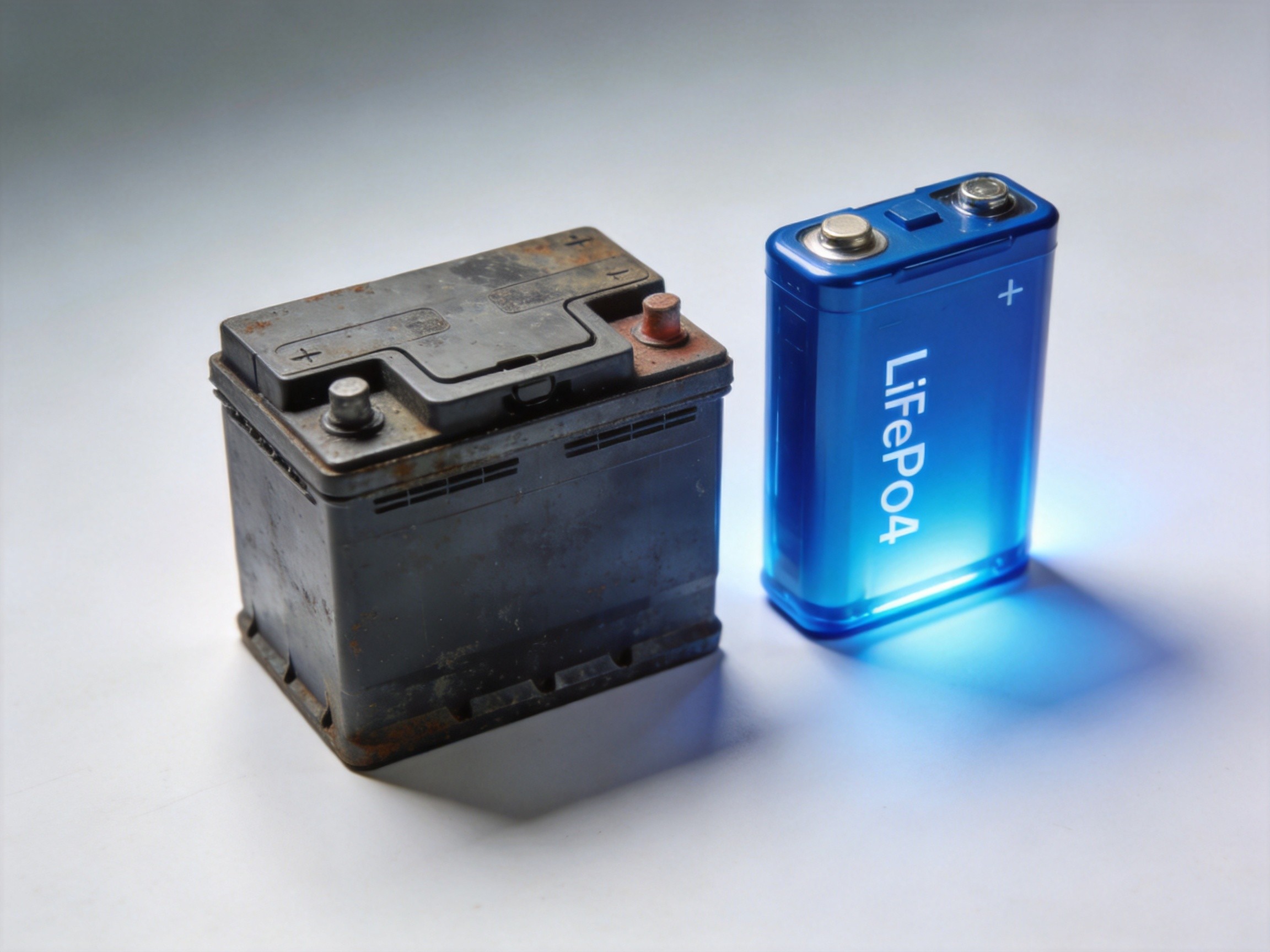
Flooded lead-acid and AGM batteries in RVs, golf carts, marine vessels, and off-grid solar systems typically fail within 2–4 years under regular deep-cycling. Owners replace them repeatedly, paying for a technology that delivers only 50% usable capacity, requires maintenance, and weighs two to three times more than the lithium alternative. A lead acid to lithium conversion 12V system is no longer a niche upgrade—it is the cost-effective default for anyone who has replaced a lead-acid bank more than once.
Why Convert from Lead-Acid to LiFePO4
LiFePO4 chemistry outperforms lead-acid on every metric that matters for deep-cycle applications. Cycle life is 5–10 times longer: a quality LiFePO4 battery delivers 3,000–6,000 cycles at 80% depth of discharge, compared to 500–1,000 cycles for a flooded lead-acid battery at 50% DoD. Usable capacity jumps from roughly 50% of rated capacity (lead-acid should not be discharged below 50% to avoid rapid sulfation) to 90% or more for LiFePO4. That means a 100Ah LiFePO4 battery provides nearly the same usable energy as a 200Ah lead-acid bank.
Weight is the other decisive factor. A typical 12V 100Ah flooded lead-acid battery weighs 28–32kg. The equivalent 12.8V 100Ah LiFePO4 battery from CMJ Solar weighs roughly one-third as much in a 33×17.2×21.5cm enclosure that fits the same battery tray. For RV owners looking to reduce tongue weight, marine operators seeking to lower vessel displacement, and golf cart fleets aiming to reduce suspension wear, the weight savings alone justify the conversion.
LiFePO4 also requires zero maintenance. There is no water to top up, no equalization charge to schedule, and no corrosive acid fumes to vent. Charge efficiency is higher too—LiFePO4 accepts charge at 95–98% efficiency compared to 70–85% for lead-acid—meaning solar arrays and alternators spend less time replacing energy lost as heat during charging. For off-grid systems where every watt-hour matters, this efficiency gain directly translates to smaller PV array requirements or longer runtime from the same array.
Drop-In Replacement: Same Footprint, One-Third the Weight
CMJ Solar's Lead-to-Lithium series is engineered as a direct form-factor replacement for common lead-acid battery group sizes. The 12.8V 100Ah model at 33×17.2×21.5cm matches the footprint of a standard GC2/Group 27 lead-acid battery, sliding into the existing tray without modification. The terminals are in the standard position, so existing cables connect directly. The 200Ah and 300Ah models use a larger 52.2×24×21.8cm or 52.2×26.8×22cm footprint that aligns with dual-purpose and commercial lead-acid form factors.
Drop-in replacement does not mean zero adjustments. The charging system must be reconfigured for LiFePO4 voltage parameters, and any battery monitoring equipment calibrated for lead-acid voltage curves will report inaccurate state of charge until recalibrated. But the physical installation—battery tray, hold-down, cable routing—requires no fabrication.
Charging Voltage Adjustments You Must Make
This is the step that determines whether a lithium conversion lasts 10 years or 2. Lead-acid chargers and converter/chargers use a three-stage profile: bulk, absorption (typically 14.4–14.8V for 12V flooded), and float (13.2–13.8V). LiFePO4 batteries require a different profile. The correct bulk/absorption charge voltage for a 12.8V (4S) LiFePO4 pack is 14.4–14.6V. The float voltage should be set to 13.5–13.8V, or float charging should be disabled entirely—LiFePO4 batteries have very low self-discharge and do not need a continuous float charge the way lead-acid does.
For 25.6V (8S) packs, double the values: bulk charge at 28.8–29.2V and float at 27.0–27.6V. Most modern RV converter/chargers, solar charge controllers, and marine battery chargers have a user-selectable LiFePO4 profile. If the existing charger does not support lithium settings, it must be replaced or an external LiFePO4-compatible charger added. Running a LiFePO4 battery on a lead-acid charge profile causes chronic undercharging (reducing usable capacity) or overcharging (accelerating degradation and creating a safety risk).
Alternator charging in vehicles and boats also needs attention. Traditional alternators with external voltage regulators may produce up to 14.8V during bulk charging, which is at the upper edge of acceptable for LiFePO4 but generally safe for short periods. However, some smart alternators in modern vehicles use variable voltage that can confuse the BMS. A DC-to-DC charger between the alternator and the lithium battery provides a regulated LiFePO4-specific charge profile and is the recommended approach for RV and marine conversions.
Choosing the Right Capacity: 15Ah to 300Ah
Small Capacity (15–30Ah): Scooters, UPS, Alarms
For lightweight applications—electric scooters, UPS backup units, security alarm panels, emergency lighting, and small robotics—the compact LiFePO4 form factors deliver significant weight savings over equivalent sealed lead-acid (SLA) batteries. The 12.8V 15Ah LiFePO4 battery provides 192Wh with a 15A discharge current in a compact 15.3×8.0×9.6cm package. The 12.8V 30Ah model steps up to 384Wh and a 30A discharge current in a 22.3×9.5×17.5cm enclosure. These replace 12V 7Ah–18Ah SLA batteries commonly found in alarm systems and small UPS units, offering longer cycle life and zero maintenance.
Mid Capacity (100Ah): RVs, Golf Carts, Marine
The 100Ah tier is the heart of the lead-to-lithium market. The 12.8V 100Ah standard model delivers 1280Wh with a 100A discharge current, suitable for RV house batteries, trolling motor power, golf cart packs (typically 4×12V for 48V systems), and small off-grid solar setups. For cost-sensitive buyers such as golf cart fleet operators and budget RV conversions, the 12.8V 100Ah Economy model uses an 80A discharge BMS instead of 100A, reducing cost for applications where continuous current draw stays below 80A. The physical dimensions are identical (33×17.2×21.5cm), making it a true drop-in alternative to the standard model.
Large Capacity (200–300Ah): Off-Grid Solar and Cabin Storage
For off-grid cabins, solar-plus-storage systems, larger vessels, and applications that previously required two or more 100Ah lead-acid batteries in parallel, the 200Ah and 300Ah models reduce connection complexity and footprint. The 12.8V 200Ah battery delivers 2560Wh with a 100A/150A discharge current in a 52.2×24×21.8cm enclosure. The 12.8V 300Ah battery provides 3840Wh with a 200A discharge current in a 52.2×26.8×22cm package—enough to run an off-grid cabin's essential loads for a full day without solar recharge.
For 24V systems, CMJ Solar offers the 25.6V 100Ah (2560Wh) and 25.6V 200Ah (5120Wh) models, which are commonly used in 24V off-grid solar, larger electric mobility devices, and industrial backup applications.
Economy vs Standard Grade: When to Choose the E Variant
The Economy (E) variant of the 100Ah model uses an 80A continuous discharge BMS compared to the standard model's 100A. This translates to a maximum continuous power of roughly 1024W (12.8V × 80A) versus 1280W (12.8V × 100A). For applications where the peak draw is well below 1000W—LED lighting, small refrigerators, phone charging, 12V water pumps—the Economy variant provides the same 1280Wh of energy capacity at a lower unit cost. It is an excellent choice for distributors serving the golf cart fleet, budget RV, and entry-level off-grid markets where high-current draws are rare. Avoid the Economy variant for applications with inverters above 1000W, electric winches, or other high-surge loads that may approach or exceed 80A.
Parallel and Series Configurations
LiFePO4 batteries of the same model, capacity, and production batch can be connected in parallel to increase total capacity, or in series to increase voltage. For parallel connection, use up to four identical 12.8V batteries in parallel to achieve up to 400Ah (for the 100Ah model) or 1200Ah (for the 300Ah model). Connect positive to positive and negative to negative using appropriately sized busbars, and ensure all batteries are at the same state of charge before connecting. For series connection, four 12.8V batteries in series create a 51.2V bank—commonly used in golf carts and 48V off-grid systems. Two 25.6V batteries in series achieve the same result. Never mix capacities, brands, or age in series or parallel strings, as current imbalance between mismatched packs can cause overcharging or overheating of individual units.
Common Conversion Mistakes
The most common mistake is failing to change the charger profile from lead-acid to LiFePO4, which is the number-one cause of premature lithium battery failure in conversions. The second is undersizing the BMS discharge current: a 100Ah battery with an 80A BMS cannot power a 1500W inverter at full load (1500W ÷ 12.8V = 117A). Always calculate maximum continuous current as inverter wattage divided by battery voltage, then add a 20% surge margin. The third is mixing old and new batteries in a parallel bank—internal resistance differences cause the newer battery to carry disproportionate current. The fourth is using battery monitors calibrated for lead-acid voltage curves: a LiFePO4 battery sits at 13.2–13.4V through most of its discharge range, which a lead-acid monitor will interpret as nearly full. Use a monitor with a LiFePO4-specific voltage profile or a shunt-based coulomb counter.
A fifth mistake is retaining the old lead-acid fuse and cable sizing. While LiFePO4's lower current draw for equivalent power often allows smaller cables, the BMS short-circuit protection can trip at very high current, and the existing fuse rating may be too high to protect the new battery during a fault. Recalculate cable gauge and fuse rating based on the new battery's maximum continuous discharge current and the actual load profile.
Final Recommendations
For RV and marine house battery replacements, the 12.8V 100Ah standard is the default choice; choose the 100Ah Economy for fleet and budget applications under 1000W. For off-grid cabins and larger solar systems, the 200Ah and 300Ah models reduce the number of parallel connections. For compact SLA replacements in scooters and UPS units, the 15Ah and 30Ah models fit the same trays. For 24V platforms, the 25.6V 100Ah and 25.6V 200Ah are direct replacements. Browse the full Lead-to-Lithium battery lineup and contact CMJ Solar for bulk pricing, OEM branding options, and charger compatibility guidance.
Need Product Recommendations?
Our team can help you select the right energy storage or solar lighting products for your project.