
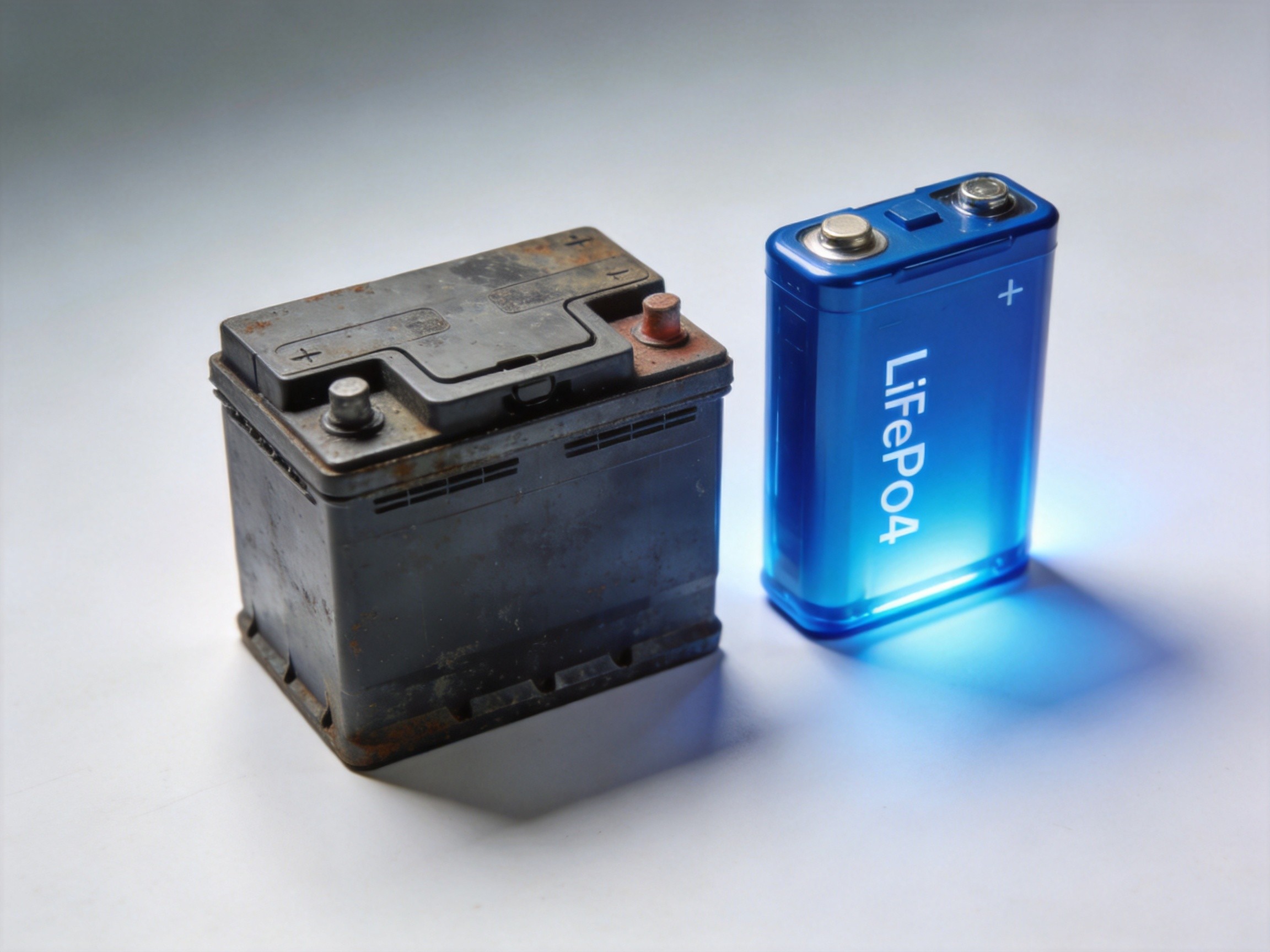
Why Convert from Lead-Acid to Lithium?
Lead-acid batteries have served as the workhorse of energy storage for decades, but their limitations — short cycle life (300-500 cycles), heavy weight, maintenance requirements, and limited depth of discharge — have become increasingly problematic for modern applications. Converting existing lead-acid systems to LiFePO4 (lithium iron phosphate) technology can extend battery life by 4-10 times, reduce weight by two-thirds, and eliminate maintenance entirely.
For B2B buyers managing fleets of equipment, solar installations, or backup power systems, the conversion from lead-acid to lithium is not just an upgrade — it is a cost-saving decision. This guide walks through the conversion process using CMJ Solar Lead-to-Lithium series products as reference examples.
Understanding Compatibility
Before beginning a conversion, it is essential to verify that the existing system is compatible with LiFePO4 batteries. The key compatibility factors are voltage matching, charging system compatibility, and load characteristics.
Voltage Matching
LiFePO4 batteries have different nominal voltages than lead-acid equivalents. A 12V lead-acid battery operates at 12.0V nominal (6 cells at 2.0V each), while a 12.8V LiFePO4 battery uses 4 cells at 3.2V each. Similarly, 24V lead-acid systems correspond to 25.6V LiFePO4, and 48V systems correspond to 51.2V LiFePO4. CMJ Solar offers Lead-to-Lithium replacements in 12.8V (15Ah, 30Ah, 45Ah, 50Ah, 60Ah, 100Ah, 200Ah, 300Ah) and 25.6V (100Ah, 200Ah) configurations to match common lead-acid system voltages.
The voltage difference is generally compatible with most charging systems. LiFePO4 batteries charge at slightly higher voltages but within the range that most lead-acid chargers can deliver. However, it is important to verify that the charger does not have a desulfation mode, which applies high-voltage pulses that can damage LiFePO4 BMS (Battery Management System) circuitry.
Charging System Compatibility
LiFePO4 batteries require a different charging profile than lead-acid. Lead-acid chargers typically use a three-stage profile (bulk, absorption, float), while LiFePO4 uses a simpler constant-current/constant-voltage (CC/CV) profile. In practice, most lead-acid chargers work adequately with LiFePO4 batteries, but for optimal performance and longevity, a dedicated LiFePO4 charger is recommended.
Solar charge controllers should be set to the LiFePO4 charging profile if the controller supports it. The float voltage for LiFePO4 is typically 13.6V (for 12.8V systems) or 27.2V (for 25.6V systems), compared to 13.5V for lead-acid — a small but important difference.
Sizing the Replacement Battery
When replacing a lead-acid battery with LiFePO4, capacity matching requires careful consideration of usable energy rather than rated capacity. Lead-acid batteries should not be discharged below 50% depth of discharge (DoD) to avoid damage, meaning a 100Ah lead-acid battery provides only 50Ah of usable energy. LiFePO4 batteries can safely discharge to 80-90% DoD, meaning a 100Ah LiFePO4 battery provides 80-90Ah of usable energy.
This means you can often replace a lead-acid battery with a LiFePO4 battery of the same rated capacity and gain 60-80% more usable energy. Alternatively, you can downsize the LiFePO4 battery to match the usable energy of the original lead-acid battery, reducing cost and weight. For example, a 200Ah lead-acid battery (100Ah usable at 50% DoD) can be replaced with a 120Ah LiFePO4 battery (96Ah usable at 80% DoD).
CMJ Solar Lead-to-Lithium series products range from 15Ah to 300Ah at 12.8V, and 100Ah to 200Ah at 25.6V. The 12.8V 100Ah model (1,280Wh) is the most popular replacement for standard 12V 100Ah lead-acid batteries, offering the same form factor with triple the cycle life.
Installation Steps
The physical installation of a LiFePO4 replacement battery is straightforward, particularly with CMJ Solar drop-in compatible designs. Follow these steps for a safe and successful conversion.
Step 1: Disconnect and Remove the Lead-Acid Battery
Power down all connected equipment and disconnect the lead-acid battery, starting with the negative terminal. Remove the battery from its compartment. Lead-acid batteries are heavy — use proper lifting techniques or equipment, particularly for larger batteries above 100Ah.
Step 2: Clean and Inspect the Battery Compartment
Clean the battery compartment, terminals, and cables. Check for corrosion on terminals and cable connectors — replace any corroded cables. Inspect the battery box or tray for damage, as lead-acid electrolyte spills may have caused corrosion over time.
Step 3: Install the LiFePO4 Battery
Place the CMJ Solar LiFePO4 battery in the compartment. The Lead-to-Lithium series is designed to match common lead-acid form factors. For example, the 12.8V 100Ah model measures 33 x 17.2 x 21.5 cm, fitting standard Group 31 battery trays. Connect the positive cable first, then the negative cable, ensuring tight and corrosion-free connections.
Step 4: Configure the Charging System
Adjust the charge controller or charger settings to the LiFePO4 profile if available. If the charger does not have a LiFePO4 mode, verify that it does not have a desulfation pulse mode. Set the bulk/absorption voltage to 14.4V (for 12.8V systems) or 28.8V (for 25.6V systems), and disable any equalization function.
Step 5: Test and Verify
Power on the system and verify that the battery is charging correctly. Check the BMS status indicator (if equipped). Monitor the first few charge-discharge cycles to ensure proper operation. CMJ Solar LiFePO4 batteries include built-in BMS protection against overcharge, over-discharge, over-current, and short circuits, providing automatic safeguards during the transition period.
Cost-Benefit Analysis
While LiFePO4 batteries have a higher upfront cost than lead-acid, the total cost of ownership is significantly lower. Over a 10-year period, a single CMJ Solar LiFePO4 battery (2,000-4,000 cycles, 5-year warranty) replaces 4-10 lead-acid batteries (300-500 cycles each). When factoring in the eliminated maintenance costs (watering, terminal cleaning, equalization charges) and reduced downtime, the LiFePO4 conversion typically pays for itself within 2-3 years.
Conclusion
Converting from lead-acid to LiFePO4 is a straightforward process that delivers immediate and long-term benefits: longer battery life, deeper discharge capability, lighter weight, and zero maintenance. CMJ Solar Lead-to-Lithium series offers drop-in compatible replacements in 12.8V and 25.6V configurations, with capacities from 15Ah to 300Ah, all backed by a 5-year warranty.
Explore our Lead-to-Lithium battery series to find the right replacement for your application, or contact our team for bulk pricing and OEM/ODM customization options.
Need Product Recommendations?
Our team can help you select the right energy storage or solar lighting products for your project.